
Quick Summary
Algorithmic trading strategies for beginners use a computer program that follows fixed rules to place trades, combining a signal, entry and exit rules, and order execution. Beginners should backtest with realistic costs, validate on unseen data, and risk only a small fixed percentage per trade.
- Write every rule in plain terms before coding it, so the system can run reliably.
- Split historical data into in-sample, out-of-sample, and walk-forward periods to reduce overfitting.
- Model realistic spreads, commissions, and slippage, since zero-cost backtests often look misleadingly profitable.
- Risk only a small fixed percentage of account equity per trade and set a daily drawdown limit.
- Test any system on a demo account before committing live capital.
Table of Contents
- What Algorithmic Trading Is and How It Works
- Trend Following and Mean Reversion Strategies Explained
- Backtesting Best Practices Before You Risk Real Money
- Choosing Automated Trading Software for MT5 and TradingView
- Risk Management Rules for Algorithmic Trading
- Infrastructure, Costs, and Regulatory Basics for US Retail Traders
- Your Next Step: Starting With a Tested MT5 System
- Frequently Asked Questions
Algorithmic Trading Strategies for Beginners: A Practical Guide (Source: U.S. Securities and Exchange Commission’s (SEC) guidance on algorithmic trading)
Last Updated: November 6, 2026
What Algorithmic Trading Is and How It Works
Algorithmic trading strategies for beginners start with one idea: a computer program follows a fixed set of rules to place trades, so your decisions are made in advance rather than under pressure.
An algorithmic trading strategy has three core components. The signal tells the system that market conditions match a setup. Entry and exit rules define exactly when to open and close a position. Order execution sends those instructions to your broker and manages fills.
Core components: signals, entry and exit rules, and order execution
A signal is usually a calculation on price data, such as a moving average crossover or a close above a recent high.
Order execution is where many beginners get surprised. Slippage, the gap between the price you expected and the price you received, grows during volatile sessions and thin liquidity.
Write every rule in plain terms before you code it. If you cannot state an entry condition in one sentence, the system cannot run it reliably.
Trend Following and Mean Reversion Strategies Explained
Most beginner-friendly algorithmic approaches fall into two families. Trend following assumes that price moves persist. Mean reversion assumes that stretched prices tend to return toward an average. The two behave very differently, so knowing which market regime suits each one matters more than the specific indicator you choose.
Trend following: moving averages and breakout rules
Trend-following systems usually enter in the direction of a sustained move. A common setup buys when a 50-period moving average crosses above a 200-period moving average and sells on the reverse cross.
The trade-off is frequent small losses during sideways markets. Trend systems pay for their occasional large winners with a string of stop-outs, which is why position sizing and patience carry so much weight.
Mean reversion: simple rules for range-bound markets
Mean reversion systems look for price to stretch too far from its average. A basic rule buys when price closes below a lower Bollinger Band and exits at the middle band.
A common mistake is applying mean reversion to a market that is trending hard. Check whether price is ranging before the system fires.
The two families behave very differently, and the table below sets out how each one works and where it struggles.
| Approach | Core assumption | Typical rule | Main weakness |
|---|---|---|---|
| Trend following | Price moves persist | 50-period MA crosses above 200-period MA | Frequent small losses in sideways markets |
| Trend following | Price moves persist | Price closes above a recent range | Stop-outs during sideways markets |
| Mean reversion | Stretched prices return to average | Buy below lower Bollinger Band, exit at middle band | Large losses if a range becomes a trend |
Backtesting Best Practices Before You Risk Real Money
Backtesting runs your rules against historical data to show how they would have performed. It is the cheapest way to find a broken idea. It is also the easiest way to fool yourself, because a strategy tuned until it looks perfect on past data usually fails on new data. That failure is called overfitting.
The three data splits every beginner should use
Professional quant researchers split historical data into three parts: in-sample, out-of-sample, and walk-forward. In-sample data is what you use to develop and tune the rules. Out-of-sample data is a separate period you never touch during development, used only once to confirm the strategy holds up. Walk-forward analysis takes this further by repeatedly optimizing on a rolling window and testing on the next unseen window, which simulates how the strategy would have performed in real time.
A common pattern is to use 60% of your data for in-sample development, 20% for out-of-sample validation, and 20% for a final walk-forward check. If the strategy fails on out-of-sample data, do not tweak it and re-test on the same period. That is how overfitting happens.
Realistic costs and slippage modeling
Your backtest must include realistic spreads, commissions, and slippage. A strategy that looks profitable with zero costs often turns negative once you add a typical spread of 1-2 pips on major forex pairs or $0.01-$0.02 per share on liquid US equities.
Watch out: many backtesting platforms default to perfect fills at the exact bar close. If your strategy enters on the close, assume you get filled at the next bar open, not the close you saw.
Common backtesting pitfalls
Look-ahead bias occurs when your rules accidentally use future data, such as a moving average that includes the current bar’s close before it is complete. Survivorship bias happens when your historical data only includes companies that still exist today, ignoring delisted or bankrupt ones. Both inflate results. Use a data source that includes delisted symbols and test on closed bars only.
Test any system on a demo account before going live.
Choosing Automated Trading Software for MT5 and TradingView
Most beginners will run their systems on MetaTrader 5 or TradingView. MT5 handles automated execution directly through Expert Advisors, while TradingView is strong for charting and alerts that you can route to a broker.
Look for software that exposes its entry and exit logic clearly, supports backtesting on your broker’s data, and lets you adjust position size and risk limits.
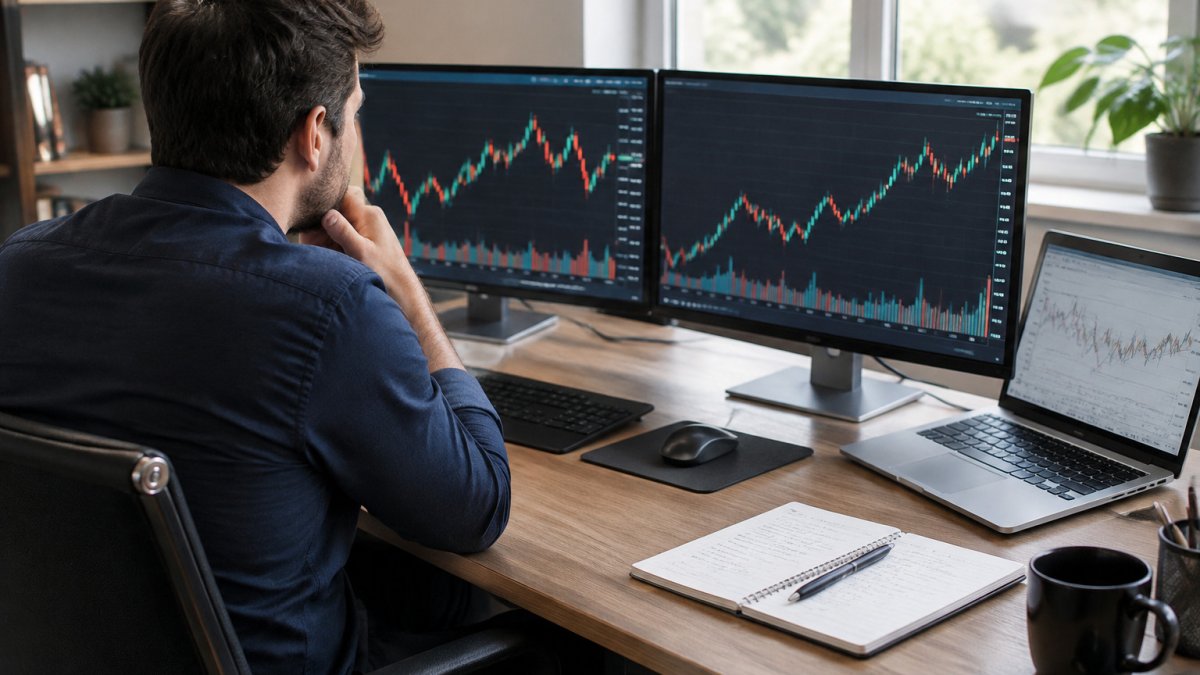
A trader at a desk with two monitors showing candlestick charts, laptop open beside a notepad, quiet home office.
Risk Management Rules for Algorithmic Trading
Risk management determines whether an automated system survives long enough to show its edge. Set a maximum risk per trade, commonly a small fixed percentage of account equity, and a maximum daily or weekly drawdown at which the system pauses.
Position sizing and drawdown limits
A common rule is to risk only a small fixed percentage of account equity per trade. Set a daily drawdown limit at which the system stops trading for the day, and consider a weekly limit as well, so that one bad stretch does not compound into a severe loss.
Automation removes emotion from entries but not from sizing decisions. If you raise position size after a winning streak, you have reintroduced the very bias the system was meant to remove. Lock your sizing rules before going live.
The psychological challenge: trusting the bot without over-intervening
Most beginners fail not because the strategy is bad, but because they interfere with it.
The solution is to define your monitoring rules in advance. Check performance weekly, not hourly.
Watch out: manually closing a losing trade that the system would have held can break the statistical edge the strategy depends on. If you cannot resist intervening, reduce your position size until you can.
Monitoring and kill switches
Set up alerts for drawdown thresholds and connection failures. A kill switch that flattens all positions and stops the system if a predefined loss is hit is a basic safeguard. Test the kill switch on a demo account before you need it live.
Monitor drawdown against the backtest. A live drawdown deeper than anything the test produced is a signal to stop and review, not to add capital.
Infrastructure, Costs, and Regulatory Basics for US Retail Traders
Running an algorithm requires a reliable connection and a machine that stays on during market hours.
Costs add up quietly. Spreads, commissions, platform fees and data subscriptions all reduce returns, so include them in every backtest.
US retail traders should confirm that their broker is registered and regulated, and understand how the Pattern Day Trader rule applies to their account size and trading frequency.
Your Next Step: Starting With a Tested MT5 System
Start small. Choose one strategy, backtest it with realistic costs, paper trade it on a demo account, and only then consider live capital with a fixed risk limit. EZMT5 gives you instant access to 11 professional MT5 Trading Systems and TradingView indicators, plus all future systems, with no contracts and two license keys per system that you can change at any time.
Ready to start with a tested system? Get started with EZMT5 and begin running professional MT5 strategies today.
Frequently Asked Questions
What is the best strategy for algorithmic trading?
No single strategy works in every market, so the best choice depends on your goals and the market you trade. Trend following tends to suit markets that move steadily in one direction, while mean reversion suits markets that oscillate within a range. Beginners usually do better starting with one simple, rule-based approach, testing it on historical data, and running it on a demo account before committing real capital. Rules that are written down and tested are far more useful than a strategy chosen by reputation alone.
Is it possible to make $1,000 a day day trading?
It is possible for some traders, but it is not a realistic expectation for most beginners. Daily income depends on account size, risk per trade, market conditions, and consistency over time. Most retail traders lose money, and a strategy that looks profitable in a short backtest can fail in live trading. Focus first on capital preservation, consistent execution, and measuring results over many trades rather than targeting a fixed daily dollar amount.
How do I backtest an algorithmic trading strategy before going live?
Start by defining exact entry and exit criteria, then run the rules against historical price data that includes several different market conditions. Record metrics such as win rate, average win versus average loss, maximum drawdown, and risk-adjusted returns like the Sharpe ratio. Split your data into an in-sample period for building the rules and an out-of-sample period for testing them, which helps reduce overfitting. After a strong backtest, run the strategy on a demo account to see how slippage and execution affect results.
Can beginners use pre-built MT5 systems to start algorithmic trading?
Yes, beginners can use pre-built MT5 systems to automate trades, but they should still understand what each system is designed to do. Review the entry and exit logic, the markets and timeframes it targets, and how it manages risk. Test any system on a demo account first, then start with small position sizes. Pre-built systems reduce setup time, yet you remain responsible for monitoring performance and deciding when a system should be paused.
What technical skills are required to implement basic trading algorithms?
Basic algorithmic trading requires comfort with trading concepts such as moving averages, support and resistance, and position sizing, along with the ability to follow structured rules consistently. Some familiarity with the MT5 platform and its settings is helpful, and basic programming knowledge helps if you want to customize logic. Many beginners start with pre-built systems or indicators and gradually learn more as they review results from their own trades.
What are the regulatory requirements for retail algorithmic trading in the US?
Retail traders in the United States who use automated systems must still comply with the rules that govern their broker and the instruments they trade. Brokers must follow the regulations that apply to them, and the official regulator websites list current requirements. Requirements for automated trading can vary by broker and product, so check your broker’s terms and the official regulator websites for current rules.
How does automated trading differ from manual trading in terms of risk management?
Automated trading executes predefined rules without hesitation, which can enforce discipline and remove emotional decisions. However, a system can also repeat a flawed rule many times if conditions change, so risk controls must be built in from the start. Manual traders can adjust on the fly but are more prone to inconsistent behavior. Automated traders should set maximum position sizes, daily loss limits, and stop-loss rules, and review performance regularly.
Can ChatGPT write a trading algorithm?
AI tools can help draft code or explain trading concepts, but the output needs careful testing before you rely on it. A generated script may contain logic errors, use incorrect order handling, or ignore risk limits. Always verify the code, test it on historical data, and run it in a demo environment. The strategy itself still needs to be defined, validated, and monitored by you.
