
Table of Contents
- Why Fraudulent Trading Signals Target Individual Traders
- Identifying Trading Signal Provider Red Flags
- How to Verify Trading Performance Claims
- Checking Broker and Platform Registration
- Capital Protection and Position-Sizing Procedures
- Treat every signal as unverified until proven otherwise
- Calculate position size from the stop, not from the signal
- Set hard drawdown limits before you subscribe
- Separate signal capital from core capital
- Use stop-loss orders and verify they are working
- Keep a reserve and avoid full deployment
- Track your own results, not the provider’s
- Reporting Suspected Trading Scams
- Protecting Your Account and Payment Security
- Frequently Asked Questions
Last Updated: October 15, 2026
Why Fraudulent Trading Signals Target Individual Traders
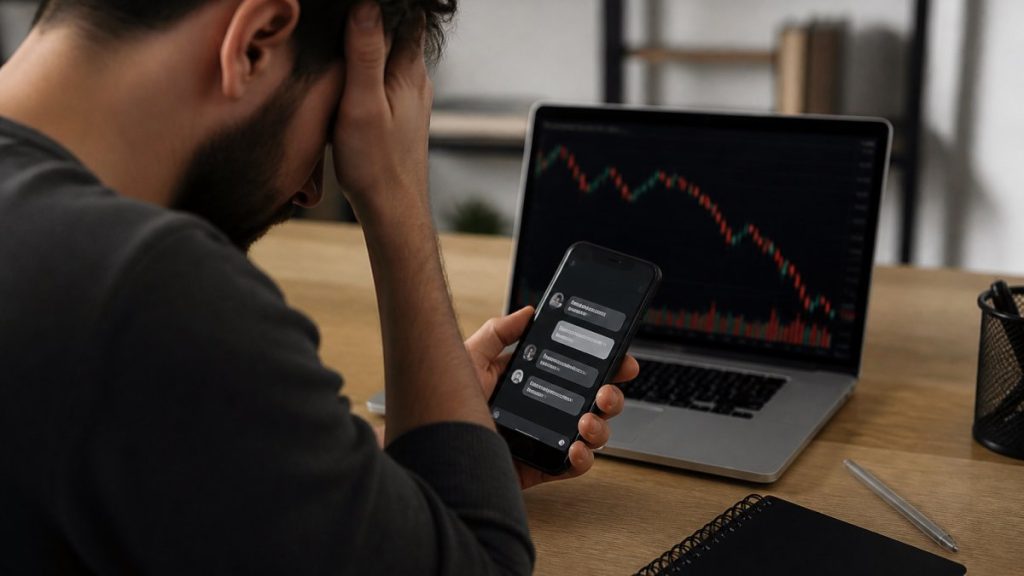
Individual traders are frequent targets of fraudulent trading signals because they lack the compliance infrastructure, risk controls, and due diligence teams institutions maintain.
Fraudulent trading signals promise unrealistic returns with minimal risk, claiming a proprietary algorithm or insider knowledge that beats the market.
A signal provider makes money from subscription fees, not profitable trades.
Identifying Trading Signal Provider Red Flags
The most obvious red flag is a promise of guaranteed returns or claims that losses are impossible.
Another red flag is vague performance documentation.
Pressure tactics signal danger. Artificial urgency, “This offer expires today,” “Only 50 slots remaining”, bypasses rational evaluation.
Unrealistic profit targets are another warning.
Finally, watch for providers who discourage questions or hide their background. Anonymity or vague credentials are red flags.
How to Verify Trading Performance Claims
Most fraudulent signal providers don’t fabricate every number, they fabricate the context around real numbers. A provider can show a genuine 400% gain on one trade while hiding the eleven losers before it. Verification strips away that manipulation.
Demand audited live results, not screenshots
A screenshot proves nothing. It can be cropped, edited, taken from a demo account, or dated before a losing streak. What you want is a verifiable track record tied to a brokerage account a third party can inspect.
Ask the provider for these four things in writing:
- The brokerage name and account number (or a masked version the broker can confirm).
- The account type, live funded account, not demo, not paper.
- The full trade history for a stated period, including losing trades, commissions, and swap/financing costs.
- The name of the auditor or verification service that reviewed the records.
If the provider cannot produce all four, treat the claim as unverified. Fraudulent operations often supply a glossy PDF with a logo resembling an audit stamp but naming no licensed firm.
Distinguish audited results from backtests and cherry-picked data
Backtests are simulations: historical price data run through rules to produce a hypothetical equity curve. They prove nothing about live execution, slippage, spread widening, or drawdown behavior.
Watch for these tells that a track record is backtested or curated rather than live:
- No losing months. Even excellent strategies have them. A curve that only rises is a simulation or a selection.
- Round-number returns. Claims like ‘10% per month, every month’ are marketing, not trading.
- No drawdown data. Ask for maximum drawdown and the longest losing streak. If the provider cannot answer, they are not tracking real performance.
- Screenshots without timestamps or account identifiers. Unverifiable by design.
- Testimonials with no verifiable identity. A name and photo prove nothing; a linked, long-standing public profile with a trading history is stronger.
Use independent tracking services and broker statements
The strongest verification is a statement issued directly by the broker. Ask the provider to authorize the broker to release a read-only statement or investor password to a third party you choose. A refusal is itself information.
Third-party trade-tracking services connect to a broker account and publish live results. When a provider claims verification through one, ask for the profile URL and check the equity curve, drawdown, trade count, and account age.
A verified profile can still be misleading if the provider runs multiple accounts and only publishes the winner. Ask whether the published account is the only account they trade, or whether other accounts exist.
Cross-check the marketing against the record
Compare the provider’s marketing claims line by line against the verified record. Common discrepancies: ‘90% win rate’ but the record shows 55%; ‘no losing months in three years’ but the record shows a 22% drawdown; ‘verified by an independent auditor’ where the auditor is the provider’s own accountant. A legitimate provider corrects the marketing or explains the gap; a fraudulent one deflects or stops responding.
Check the auditor’s credentials
If a provider claims an audit, verify the auditor. In the United States, public accountants are licensed at the state level, and you can confirm a firm’s standing through the state board of accountancy where it is registered (Boards of Accountancy). An audit signed by an unlicensed firm, an offshore entity with no verifiable address, or the provider’s own bookkeeper is not independent.
State board of accountancy lookup for verifying audit firm licensing
Set a verification standard before you pay
Decide in advance what evidence you require, and do not subscribe until you have it. A workable standard:
- At least 12 months of live, funded trading history.
- Broker-issued statements or a read-only investor password for independent review.
- Full trade list including losers, fees, and financing costs.
- A named, independently verifiable auditor or tracking service.
- Marketing claims that match the record within a reasonable margin.
If a provider cannot meet that bar, walk away. Legitimate signal providers will not object to being verified.
Checking Broker and Platform Registration
Before sending money, verify your broker or platform is regulated. In the United States, FINRA maintains a public database of registered brokers and advisers, use BrokerCheck to confirm registration status (About BrokerCheck).
Check whether the broker is registered with the SEC for securities or the CFTC for futures and forex.
Look for a physical address and contact information. Legitimate brokers have verifiable offices and customer service teams; fraudulent operations use shell addresses or email and phone only.
Verify the platform’s security: encryption for account access and fund transfers, two-factor authentication, and displayed security certifications. Fraudulent platforms often lack these entirely.
Capital Protection and Position-Sizing Procedures
Following someone else’s signals changes the risk equation. You don’t control the entry, exit, or reasoning, only how much capital you expose to each call. Position sizing and exposure limits are your most important defense.
Treat every signal as unverified until proven otherwise
Assume every signal is wrong, not because the provider is necessarily fraudulent, but because you have no independent way to know whether the trade will work. Size accordingly.
A practical starting framework:
- Risk no more than 0.5% to 1% of account equity per signal while evaluating a provider. If the signals are legitimate, scale up later; if not, you have limited the damage.
- Cap total open exposure across all signals at 3% to 5% of equity. If a provider sends five signals in one day, you don’t need to take all five. Correlated trades, three long positions in the same sector or currency pair, behave like one oversized trade.
- Cap total exposure to any single provider at 10% of trading capital. This prevents one bad provider from taking down your account even if every other decision is sound.
Calculate position size from the stop, not from the signal
Many providers give an entry and target but no stop. Define one anyway. Position size depends on three numbers:
- Account equity, current value, not the value when you opened it.
- Risk per trade, the dollar amount you’re willing to lose, as a percentage of equity.
- Stop distance, the distance from entry to your stop, in price terms.
The formula: position size = (equity × risk %) ÷ stop distance.
Example: a $25,000 account, 1% risk, and a 50-pip stop. Risk is $250. If each pip is worth $10 on a standard lot, the stop distance is $500 per lot, so the correct size is half a lot. If the signal implies a full lot, it’s oversized, cut it.
If a signal provider never mentions stops, assume the trade is unbounded on the downside and size as if the stop is at least twice the distance you would normally use. That forces a smaller position and protects you from the provider’s omission.
Set hard drawdown limits before you subscribe
Decide in advance how much of your account you’re willing to lose following a provider, and write it down:
- Per-trade loss limit: the dollar amount from the position-sizing rule above.
- Weekly loss limit: stop following signals for the week if you hit, for example, 3% of equity in losses.
- Provider drawdown limit: stop following a provider permanently if your account drops 15% to 20% from its peak. Do not average down.
- Account-level circuit breaker: if equity falls 25% from its high-water mark, stop trading and review every provider before resuming.
Pick these numbers before you’re in a drawdown, because in a drawdown you will rationalize.
Separate signal capital from core capital
Do not follow signals with money you cannot afford to lose. Keep signal-following capital in a separate account from retirement savings, emergency funds, and long-term investments. Fund it with a fixed amount, say, $5,000 or $10,000, and never add from other accounts. Withdraw profits if it grows; don’t top it up from savings if it shrinks. This creates a natural ceiling on total loss.
Use stop-loss orders and verify they are working
A stop-loss order instructs the broker to close a position when price reaches a specified level. Place one on every trade, even if the provider doesn’t mention it, and verify it’s live in the platform, some platforms accept the order but don’t transmit it until triggered, which can fail during fast moves.
Know the difference between a stop-loss and a stop-limit. A stop-limit may not fill at all in a fast market, leaving you in a losing position. For capital protection, a plain stop-loss (market on trigger) is usually safer.
Keep a reserve and avoid full deployment
Never deploy 100% of signal capital at once. Keep at least 20% to 30% in reserve to absorb slippage and unexpected losses and avoid the psychological pressure of needing every trade to work.
Track your own results, not the provider’s
The provider’s published performance is not your performance. Your results depend on when you entered, how you sized, whether you followed every signal, and what your broker charged. Keep a log: date, signal, entry, exit, size, and P&L. After 30 to 50 trades, compare your results to the provider’s claims. A persistent gap is a signal in itself.
Capital protection when following signals is not about picking better signals. It is about making sure that no single signal, no single provider, and no single bad week can take you out of the game. Size small, cap exposure, set drawdown limits in advance, and keep signal capital separate from money you need.
Reporting Suspected Trading Scams
If you suspect you’ve been targeted by a fraudulent trading signal operation, report it immediately.
The CFTC handles forex and futures fraud complaints.
Your state’s Attorney General also investigates consumer fraud.
If you’ve lost money, report to the FBI’s Internet Crime Complaint Center (IC3).
Document everything: emails, marketing materials, transaction records, and performance statements. This strengthens any complaint and helps authorities build a case.
Protecting Your Account and Payment Security
Protect your trading account with strong passwords and two-factor authentication.
Enable two-factor authentication.
Never share login credentials with anyone, including the signal provider.
Be cautious with payment methods.
Verify the payment recipient before sending money. Scammers create sites mimicking legitimate providers with similar domain names.
Monitor your account regularly. Check statements weekly for unauthorized trades, unexpected fees, or suspicious activity.
Protecting your capital from fraudulent trading signals requires vigilance at every stage.
Frequently Asked Questions
How can you tell if a trading signal is a scam?
Fraudulent trading signals typically promise guaranteed returns, lack transparent performance records, and pressure you to invest quickly. Legitimate signal providers show independently verified track records, disclose fees upfront, and allow you to test with small positions first. Check whether the provider is registered with the SEC or FINRA, and verify their claims through third-party sources before depositing capital.
How do you verify a trading signal provider’s performance claims?
Request audited performance statements or third-party verification reports. Ask for live account statements, not just backtested results, which can be manipulated. Check if the provider is registered with financial authorities and whether independent review sites document their actual results.
How do I report a trading scammer?
Report suspected fraud to the SEC’s Complaint Center (sec.gov/complaint) or FINRA’s fraud hotline. If the scammer operates through a specific broker, file a complaint with that broker’s compliance department. Document all communications, transaction records, and performance claims before reporting. The FBI’s Internet Crime Complaint Center (IC3) also accepts reports of investment fraud, which helps law enforcement identify patterns across multiple victims.
What should I do if I’ve lost money to fraudulent trading signals?
Stop all transfers immediately and document every transaction and communication. Contact your bank or payment processor to dispute unauthorized charges. File a complaint with the SEC, FINRA, and IC3 with complete records. Consider consulting a securities attorney if the loss is substantial. Report the fraud to your state’s attorney general office as well. Recovery is difficult but official reports create a record that may help other traders and support regulatory enforcement action.