

Table of Contents
- Automated Trading Indicators vs Manual Analysis: Key Differences at a Glance
- Manual Trading: Pros, Cons, and the Emotional Toll
- Automated Trading Indicators: Benefits, Backtesting, and Execution Speed
- Manual vs Automated Forex Trading: Time, Flexibility, and Market Analysis
- Risk Management in Automated Trading: Drawdown, Slippage, and Portfolio Diversification
- Best Automated Trading Software for MT5 and TradingView in 2026
- Hybrid Trading Models: Combining Automated Indicators with Manual Analysis
- Conclusion: Matching the Approach to Your Trading Style
- Frequently Asked Questions
Last Updated: September 10, 2026

Automated Trading Indicators vs Manual Analysis: Key Differences at a Glance
The core difference between automated trading indicators vs manual analysis comes down to who makes the final call: a predefined rule set or a human reading the market in real time. Automated trading indicators generate signals from price data; manual analysis relies on a trader’s reading of chart patterns, news, and context. At EZMT5, we build systems for traders who want automation’s speed without giving up oversight.
The gap shows up fastest in execution: an automated system acts the moment conditions are met, while a manual trader must be watching, decide, and click.
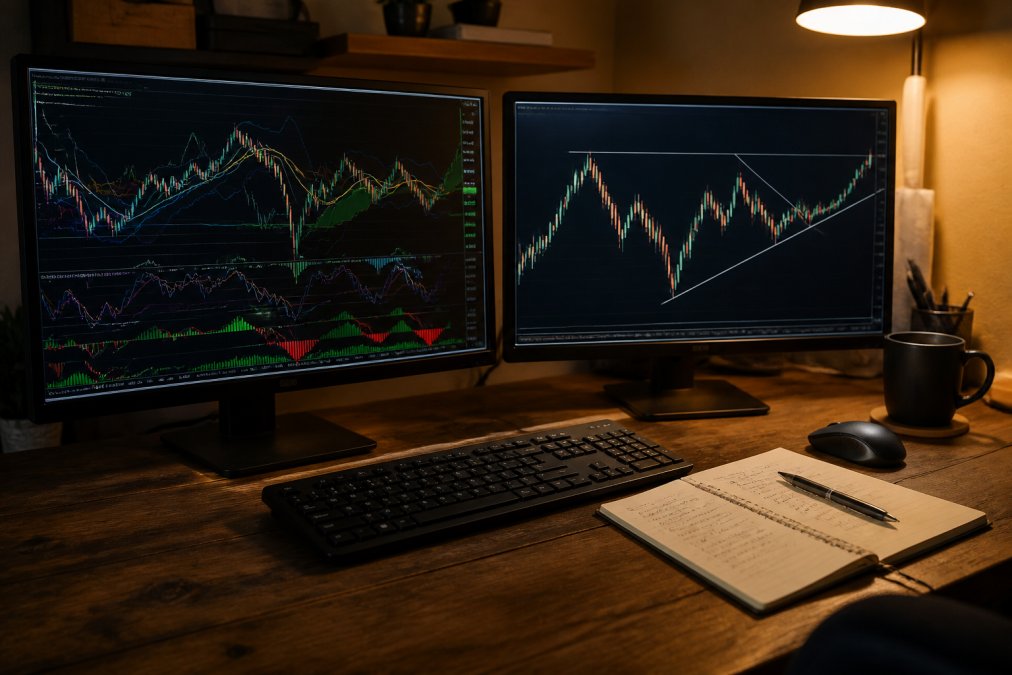
Comparison Table: Speed, Emotion, and Control
| Factor | Automated Indicators | Manual Analysis |
|---|---|---|
| Execution speed | Immediate on signal | Depends on trader reaction |
| Emotional load | Low during execution | High, decisions feel personal |
| Control | Rule-bound, less discretionary | Full discretion at every step |
| Best for | Systematic, repeatable strategies | Nuanced, context-heavy reads |
| Weakness | Rigid in unusual conditions | Inconsistent under stress |
Manual Trading: Pros, Cons, and the Emotional Toll
Manual trading gives you complete control over every entry and exit, which is exactly why it is so demanding. You can react to news, weigh volatility, and override a signal that feels wrong, flexibility that is real, and for some traders the whole point.
The cost is consistency. Trading psychology research finds that fear and greed distort decisions, and a manual trader faces that pressure on every trade. Much of the work is emotional, not analytical: you can read a chart pattern perfectly and still exit early because the position moved against you.
- Pro: Full discretion on every decision
- Pro: You can factor in context no rule captures
- Con: Emotional discipline is hard to sustain across dozens of trades
- Con: Screen time adds up fast
The most common manual trading mistake is moving a stop loss after entering a trade. It feels like giving the position room to breathe, but it usually turns a small planned loss into a large unplanned one.
Automated Trading Indicators: Benefits, Backtesting, and Execution Speed
Automated trading indicators remove the moment-to-moment hesitation that costs manual traders money. A defined rule set fires the trade, and execution speed is measured in milliseconds, not the seconds a human needs to react (sec.gov).
Backtesting is where these systems earn trust. Before risking capital, run a strategy against historical data to see how it behaves across market conditions. This is not a guarantee of future results, and any system that looks flawless deserves skepticism. A realistic backtest shows drawdown, win rate, and how the strategy handles choppy markets, not just a smooth equity curve.
Technical indicators like moving averages and the relative strength index form the building blocks of most automated systems. Combine a few, and you get trading signals that fire without you watching every tick.
When you evaluate a backtest, look at the worst losing streak, not the total return. A strategy that survives a brutal drawdown is worth more than one with a prettier headline number.
Manual vs Automated Forex Trading: Time, Flexibility, and Market Analysis
The time commitment is where manual vs automated forex trading diverges most sharply. Forex runs around the clock, and no human can watch every session. An automated system covers the hours you sleep, crucial for professionals who cannot sit at a screen during the London or Tokyo sessions.
Flexibility cuts the other way. A manual trader can adapt to a surprise central bank statement in seconds. An automated system does what it was told, a strength until the market does something the rules never anticipated.
For market analysis, the split is similar: manual analysis shines when weighing qualitative context, while automated indicators shine when processing real-time data across multiple pairs and timeframes without fatigue. Most traders end up wanting both, which is why hybrid models exist.
Risk Management in Automated Trading: Drawdown, Slippage, and Portfolio Diversification
Risk management in automated trading is not optional, because automation removes the human brake that stops a bad day from becoming a disaster. Three concepts matter most, drawdown, slippage, and diversification, plus a fourth most articles skip: the security of the connection between your system and your broker.
Drawdown is the peak-to-trough decline in your account equity. Every strategy has one, and the question is whether you can survive it emotionally and financially. Size positions so the expected maximum drawdown is no more than a fraction of capital you could lose without changing your life. If a backtest shows a 30% max drawdown, assume live conditions will be worse (sec.gov).
Slippage is the gap between the price your signal expected and the price your order actually received. It widens when liquidity dries up, around major economic releases, at session opens, and during volatility spikes (cftc.gov). Automated execution does not eliminate slippage; it makes it consistent and measurable. Model a realistic slippage assumption per trade, because a strategy that only works with perfect fills does not work in practice.
Diversification spreads risk across uncorrelated strategies so one bad market does not sink everything. Running several systems is itself risk control, but only if they are genuinely uncorrelated. Two trend-following systems on correlated pairs will draw down together; a trend system plus a mean-reversion system on a different asset class is closer to real diversification.
API and script security is the risk nobody puts in the comparison table. When you connect an automated system to a broker, you are typically issuing API keys or running third-party scripts with order permissions. A few practical rules:
- Scope your API keys to trading only. Never grant withdrawal permissions to a key a bot uses.
- Rotate keys on a schedule and immediately if a vendor relationship ends.
- Audit third-party indicator scripts before running them live. A script with order-sending permissions can act on your account without your knowledge.
- Prefer brokers and platforms with documented API rate limits and IP allowlisting, so a leaked key cannot be used from an unknown location.
On the regulatory side, automated trading in the United States operates under the same oversight framework as any other trading activity. The SEC and CFTC both have rules touching algorithmic order flow, and FINRA has published guidance on supervisory controls for firms using automated systems. For an individual retail trader, the practical takeaway is simpler: your broker’s customer agreement governs what automated activity is permitted, and some brokers restrict or require pre-approval for algorithmic orders. Read those terms before you go live.
- Set a maximum drawdown you will tolerate before pausing a system, and write it down before you start
- Account for slippage in your backtest assumptions, not just ideal fills
- Diversify across genuinely uncorrelated strategies rather than doubling down on one
- Lock down API keys with trading-only scope, rotation, and IP restrictions
The single most important risk rule for automated trading: decide your maximum drawdown before you go live, and honor it. A system you cannot emotionally survive is a system you will abandon at the worst moment, and an unsecured API key is a risk no drawdown limit can protect you from.
Best Automated Trading Software for MT5 and TradingView in 2026
The best automated trading software for MT5 and TradingView depends on whether you want to build your own rules or start with proven systems. Some platforms give you a scripting environment; others hand you finished, optimized systems you can run immediately.
| Platform | Approach | Best For | Free Tier |
|---|---|---|---|
| EZMT5 | Pre-built MT5 systems and TradingView indicators | Traders who want to start immediately | No |
| TrendSpider | AI-driven automated technical analysis | Active day traders automating charting | No |
| TradingView | Custom indicators via Pine Script | Hybrid manual plus scripted workflows | Yes |
| Bitsgap | Pre-built crypto trading bots | Crypto traders automating execution | Yes |
Our top pick for traders who want to trade right after download is EZMT5. It provides instant access to 11 professional, fully built, and optimized MT5 trading systems and TradingView indicators, plus all future systems, with no contract and two license keys per system you can change anytime. If you would rather write your own rules, TradingView’s Pine Script editor is more flexible, though it assumes coding comfort.
TrendSpider earns its place for traders who want AI-driven pattern recognition, but expect a learning curve if you are new to algorithmic parameters.
TradingView remains the standard for hybrid workflows, combining manual charting with custom automated signals.
Bitsgap is a strong choice for crypto automation specifically, with pre-built bot templates, though it does not cover forex or equities.
Hybrid Trading Models: Combining Automated Indicators with Manual Analysis
Hybrid trading models combine automated indicators with manual analysis, using the system for execution and the trader for context. This addresses the biggest weakness of each pure method: the useful framing is not man versus machine but a division of labor.
A concrete hybrid workflow. Here is how a workable semi-automated setup looks in practice:
- You define the thesis manually. Before any automation runs, you decide which markets you are trading, what regime you believe you are in (trending, ranging, or volatile), and what would invalidate that view. This is the part no indicator does well.
- You encode the parameters, not the decisions. Instead of letting the bot decide everything, you set the guardrails: which pairs or instruments, what session hours, maximum position size, maximum daily loss, and the specific entry conditions the indicator must satisfy.
- The automated indicators scan and signal. Moving averages, RSI, and similar tools generate candidate setups across multiple timeframes without you watching every tick.
- You review and approve. Signals that pass your context filter get approved; signals that fire during a news event you flagged get skipped. This is the human-in-the-loop step.
- Automated execution handles entry, stop, and target. Once approved, the system manages the trade mechanically, which removes the moment-to-moment hesitation that costs manual traders money.
Setting parameters from manual analysis. The most useful hybrid skill is translating a discretionary read into a rule. If your manual analysis says “only take longs when price is above the 200-period moving average and volatility is expanding,” that becomes two filter conditions in your system. The rule need not capture your full judgment, only the conditions under which your judgment is worth acting on. Traders who encode every nuance end up with an overfit system that fails live; those who encode only the guardrails get the best of both.
The psychological cost of automation. Handing every decision to a system can leave traders anxious and second-guessing, especially during drawdowns. This automation anxiety shows up most acutely during black-swan events, a flash crash, a surprise rate decision, a geopolitical shock, when the system keeps executing rules that no longer match the world. A hybrid model keeps a human in the loop, which tends to make traders more willing to let a system run through a rough patch. The trade-off is real: a human can also override at exactly the wrong moment, so define in advance which conditions justify an override and which do not.
Hardware and latency requirements. As you lean toward automation, the physical setup starts to matter. Running multiple systems on a reliable machine with a stable connection is not optional if you want execution speed to hold up. Serious traders often run their systems on a virtual private server (VPS) near their broker’s data center to reduce round-trip latency, and they monitor uptime because a dropped connection during an open position is a real risk. Slippage and fill quality degrade when your connection is slow, and no indicator can compensate.
Regulatory and broker rules. Automated trading operates under the same oversight as any other trading activity in the United States, and brokers and platforms set their own rules for algorithmic orders. Some require pre-approval, some restrict certain order types, and some limit API access to specific account types. Check your broker’s terms before running a system live, and keep records of what your system is authorized to do.
Traders who want automated execution but refuse to give up a final say on entries and exits. A hybrid model fits best when your strategy needs context a rule cannot capture, and when you are willing to define, in writing, the conditions under which you will and will not override the machine.
Conclusion: Matching the Approach to Your Trading Style
Automated trading indicators vs manual analysis is not a debate with one winner. It is a question of fit: your time, your temperament, and how much control you want over each decision. Manual trading rewards the discipline to stay consistent under pressure; automation rewards those who want repeatable rules and speed.
For most serious traders, the answer is a hybrid that leans on automation for execution and manual judgment for context. EZMT5 is built for exactly that: 11 professional, fully built MT5 trading systems and TradingView indicators, real-time trade opportunities, and two license keys per system you can change anytime, all with no contract. Get started with EZMT5 and put automated precision behind your trading decisions.
Frequently Asked Questions
Is automated trading more profitable than manual trading?
Profitability depends on strategy quality, market conditions, and discipline, not automation alone. Automated trading indicators remove emotional hesitation and execute faster, which can improve consistency. Manual analysis allows nuance in unusual markets but is prone to fear and greed. Many traders find that a hybrid approach, using automation for execution and manual review for strategy adjustments, produces the most stable results over time.
What are the primary risks of relying solely on automated trading indicators?
Automated systems can fail during unexpected market volatility, experience slippage, or suffer from latency issues. Over-optimized backtests may not hold up in live conditions. Hardware failures or API disconnections can leave positions unmanaged. Risk management in automated trading requires setting stop-losses, position sizing, and drawdown limits, plus regular monitoring to catch anomalies that algorithms miss.
Can manual analysis outperform algorithmic trading systems?
In certain conditions, yes. Manual analysis can adapt to breaking news, geopolitical events, or subtle chart patterns that algorithms may not be programmed to recognize. However, manual trading often struggles with emotional discipline and speed. Algorithmic systems excel at backtesting, consistent execution, and processing real-time data across multiple markets. The best traders often combine both: using algorithms for screening and execution while applying manual judgment for strategy shifts.
How do professional traders combine automated indicators with manual analysis?
Professionals use a hybrid model: automated indicators generate trading signals and execute trades, while manual analysis sets the overall strategy, selects markets, and adjusts risk parameters. For example, a trader might use an MT5 system for entry and exit precision but manually review economic calendars or adjust exposure before major news events. This blend captures automation’s speed and discipline while retaining human oversight for context.
What technical skills are required to implement automated trading systems?
Basic automated trading software often requires no coding if you use pre-built systems. For custom indicators on platforms like TradingView, knowledge of Pine Script or similar languages helps. Understanding API integration, backtesting, and risk management is beneficial. Many traders start with ready-made systems and gradually learn to modify parameters. Platforms like EZMT5 provide fully built systems that work out of the box, lowering the technical barrier.