

Table of Contents
- What Makes a Foreign Exchange Broker Right for You
- NFA-Registered Forex Brokers: Regulatory Requirements and Verification
- Forex Account Minimum Deposit Requirements Across Platforms
- Currency Pairs, Spreads, and Trading Execution
- Trading Platforms, Tools, and Technical Analysis
- Leverage, Margin Requirements, and Risk Management
- Customer Support, Education, and Account Types
- Conclusion
Last Updated: August 11, 2026
What Makes a Foreign Exchange Broker Right for You
Choosing the right foreign exchange broker determines whether you’ll execute trades efficiently or spend months fighting poor spreads, slow platforms, and inadequate tools. The best foreign exchange broker for your needs depends on your trading style, account size, and whether you prioritize advanced platforms or simplicity.

For serious traders in the United States, regulatory oversight matters above everything else. The Commodity Futures Trading Commission (CFTC) and National Futures Association (NFA) enforce strict rules on use, margin requirements, and capital reserves. Any foreign exchange broker worth considering must be fully regulated by both agencies. This protects your deposits and ensures the broker isn’t taking the other side of your trades.
Beyond regulation, the practical differences between brokers come down to execution quality, spreads, and platform features. A broker offering tight spreads on major currency pairs like EUR/USD might charge wider spreads on exotic pairs. Some platforms excel at technical analysis with built-in indicators and charting tools, while others focus on simplicity and mobile access. The right choice depends on whether you’re scalping five-minute charts or holding positions for weeks.
Account minimums vary widely. Some brokers accept accounts with minimal deposits, while others require $10,000 or more to unlock competitive spreads. If you’re testing a strategy with $500, you need a different broker than someone deploying $50,000. Similarly, use limits in the US are capped at 50:1 for major pairs and lower for exotics, so all regulated brokers operate within the same constraint, but how they structure margin requirements differs.
NFA-Registered Forex Brokers: Regulatory Requirements and Verification
An NFA-registered foreign exchange broker must maintain specific capital reserves, segregate customer funds, and pass regular audits. The National Futures Association maintains a public database where you can verify any broker’s registration status and disciplinary history. Before opening an account, check the NFA’s Background Affiliation Status Information (BASIC) system to confirm the broker is legitimate.
The CFTC limits use for retail traders to 50:1 on major currency pairs and 20:1 on minor pairs and exotics. This regulatory cap applies uniformly across all NFA-registered brokers, so no broker can legally offer higher use to US retail clients. Some brokers advertise higher use for professional accounts, but those require specific credentials and net worth thresholds.
Segregation of customer funds is non-negotiable. A fully regulated foreign exchange broker must keep client money in separate accounts at approved banks, not commingled with operational funds. If the broker fails, your deposits are protected, at least in theory. In practice, this protection has held up through multiple broker collapses over the past decade.
Verification is straightforward. Visit the NFA website, search the broker’s name, and confirm the registration is active. Look for any disciplinary actions or customer complaints. A clean record doesn’t guarantee good execution, but a hidden registration or past violations should disqualify a broker immediately.
Forex Account Minimum Deposit Requirements Across Platforms
Minimum deposit requirements range from zero to $25,000 depending on the broker and account type. FOREX.com accepts accounts with a minimum deposit of $100, though they recommend at least $2,500 for more flexibility and better risk management. OANDA has no minimum deposit for standard accounts but charges wider spreads without their Core Pricing option, which requires a higher deposit.
Interactive Brokers has no minimum deposit for cash accounts, but a $2,000 minimum deposit is required for margin accounts. Charles Schwab’s thinkorswim platform requires a minimum trade size of 10,000 units, which means you need at least $500 in margin to open a position in most pairs.
tastyfx accepts a minimum deposit of $1, making it accessible for traders testing strategies with limited capital. eToro allows micro-trades starting at $10, though spreads are wider than professional brokers. If you’re starting with under $1,000, eToro or Trading.com are practical options despite higher costs.
Higher minimums typically unlock better pricing. A $10,000 account at OANDA qualifies for Core Pricing with 0.4 pip spreads on EUR/USD plus $5 per $100,000 traded. The same trade at a $500 account costs wider spreads. This creates a tier system: deposit more, pay less per pip.
Account minimums also affect position sizing. A $500 account with 50:1 use lets you control $25,000 worth of currency. That’s enough for one standard lot on a major pair, but you can’t diversify across multiple positions. A $5,000 account gives you flexibility to test multiple strategies simultaneously.
Currency Pairs, Spreads, and Trading Execution
The spread is the difference between the bid and ask price, what you pay to enter a trade. On EUR/USD, a 1.2 pip spread means you’re paying 1.2 pips of slippage before the trade moves in your direction. Over hundreds of trades, tight spreads compound into significant savings.
Major currency pairs like EUR/USD, GBP/USD, and USD/JPY have the tightest spreads because they trade the highest volume. Most brokers quote EUR/USD spreads between 0.4 and 2.0 pips depending on account type. Minor pairs like EUR/GBP or USD/CAD trade with slightly wider spreads. Exotic pairs like USD/TRY or USD/ZAR can have spreads of 5-20 pips, making them expensive to trade frequently.
FOREX.com’s RAW Spread account offers 0.0 pip spreads on majors but charges $7 commission per $100,000 traded. Interactive Brokers goes even tighter with spreads as narrow as 0.1 pips plus commissions starting at $2 per trade. For high-volume traders, these commission-based models beat spread-only pricing. For occasional traders, commission-free spreads are simpler.
Execution speed matters when spreads are tight. A 1 millisecond delay in execution can slip your entry by 0.5 pips. Brokers with direct market access (DMA) and low-latency connections execute faster than those routing orders through multiple intermediaries. This difference is negligible for swing traders holding positions for days but critical for scalpers.
Swap rates (rollover fees) apply when you hold a position overnight. If you’re long EUR/USD, the interest rate differential between the euro and dollar determines whether you earn or pay overnight fees. Some brokers offer negative swap rates on certain pairs, effectively paying you to hold the position. Check swap rates before choosing a broker if you trade on longer timeframes.
Trading Platforms, Tools, and Technical Analysis
MetaTrader 5 (MT5) is the industry standard for forex trading. Most brokers offer MT5 access, though some US brokers including OANDA don’t support it due to regulatory complications. If MT5 is essential to your workflow, verify the broker offers it before committing.
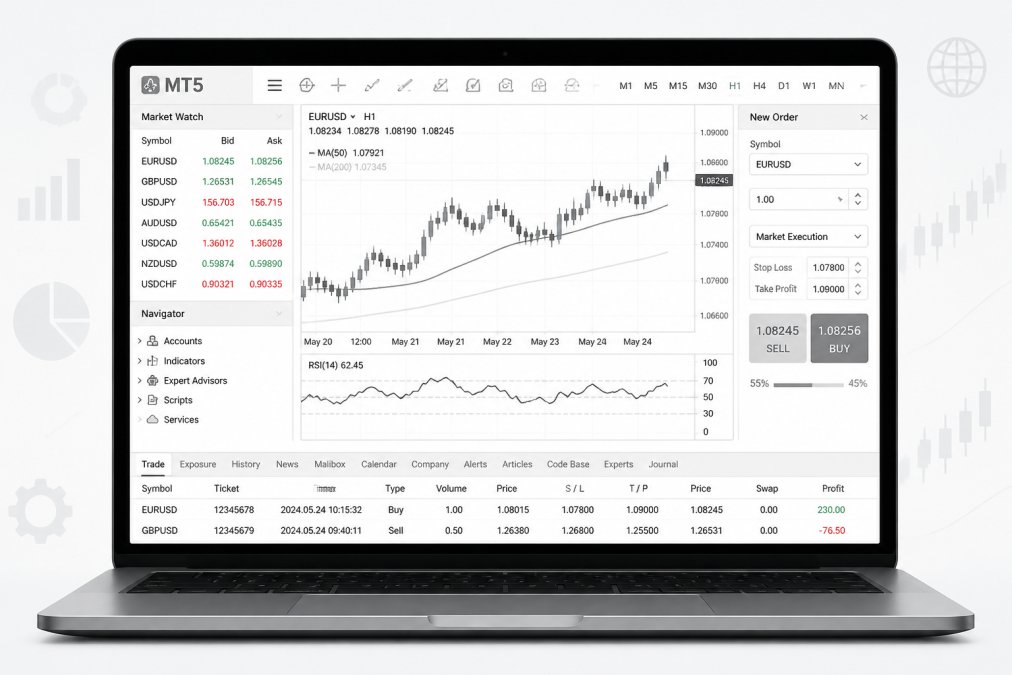
Charles Schwab’s thinkorswim platform rivals MT5 for charting and analysis. It includes advanced technical indicators, backtesting tools, and market scanning. The platform has a steep learning curve but rewards serious traders with depth. FOREX.com’s Advanced Trading Platform and OANDA’s Trade platform offer similar capabilities.
TradingView integration is increasingly common. Many brokers now allow you to execute trades directly from TradingView charts, combining the best charting software with live order execution. This eliminates the need to switch between platforms. Interactive Brokers and several smaller brokers support this workflow.
Mobile trading matters if you need to monitor or exit positions outside your desk. All major brokers offer mobile apps, but quality varies. tastyfx and eToro prioritize mobile experience with intuitive interfaces. FOREX.com and Charles Schwab’s mobile apps are functional but less polished than desktop platforms.
Technical analysis tools built into the platform should include moving averages, RSI, MACD, Bollinger Bands, and at minimum 20 candlestick patterns. Advanced traders need custom indicator support and the ability to write scripts or Expert Advisors. MT5 excels here with MQL5 scripting. Proprietary platforms like thinkorswim offer similar flexibility.
use, Margin Requirements, and Risk Management
use in the US is capped at 50:1 for major currency pairs under CFTC rules. This means a $1,000 account can control $50,000 worth of currency. The tradeoff is that a 2% adverse move wipes out your account. use is a double-edged sword, it amplifies both gains and losses.
Margin requirements determine how much capital you must hold to maintain a position. If a broker requires 2% margin on EUR/USD, you need $2,000 in your account to hold a standard lot ($100,000 notional value). Some brokers offer tiered margin, reducing requirements as your account grows. Others charge flat rates across all account sizes.
Stop-loss orders are your primary risk management tool. A properly placed stop-loss limits losses on any single trade. Professional traders risk 1-2% of account capital per trade, which means a $5,000 account risks $50-100 per trade. This discipline prevents emotional decisions and catastrophic losses.
Hedging restrictions apply to some brokers. US regulations allow hedging (holding long and short positions in the same pair simultaneously), but some brokers restrict it. If your strategy requires hedging, confirm the broker allows it before opening an account.
Position sizing rules should be mechanical, not emotional. Calculate your position size based on account size, risk tolerance, and stop-loss distance, not on how confident you feel about a trade. A foreign exchange broker platform should make it easy to calculate position size. MT5 includes position sizing calculators; others require manual calculation.
Customer Support, Education, and Account Types
Customer support quality separates competent brokers from great ones. Charles Schwab and tastyfx offer 24/5 phone support from specialists who understand forex trading. FOREX.com and OANDA provide similar support but with longer wait times during peak hours. eToro’s support relies heavily on chatbots and email, which is slower.
Educational resources matter for developing traders. Charles Schwab offers extensive forex education, webinars, and trading courses. OANDA provides research tools and market analysis. Interactive Brokers offers less educational content but serves experienced traders who don’t need hand-holding. eToro’s social trading community provides peer learning, which appeals to some traders.
Account types vary by broker. Standard accounts charge spreads only. RAW Spread or ECN accounts charge tight spreads plus commissions. Pro accounts offer lower margin requirements and higher use (for qualified traders). Demo accounts let you test platforms and strategies with virtual money, all major brokers offer these, and you should use one before depositing real capital.
Inactivity fees apply if you don’t trade for 12 months. FOREX.com charges $15 monthly after 12 months of inactivity. OANDA charges a monthly inactivity fee of $20 after 12 months of no trading activity. eToro previously charged a $10 monthly inactivity fee after 12 months, but currently does not apply an inactivity fee. Charles Schwab and tastyfx don’t charge inactivity fees. If you’re testing a long-term strategy without frequent trades, this matters.
Withdrawal fees and processing times vary. Most US brokers process withdrawals within 2-5 business days. Some charge flat fees ($10-25); others charge percentage-based fees. eToro charges a flat $5 fee for withdrawals from USD accounts. FOREX.com does not charge internal withdrawal fees, except for a 0.50% currency conversion fee, but wire transfers may incur a $25 fee within the US and $40 for international wires, with no fees for withdrawals greater than $10,000. OANDA does not charge withdrawal fees for credit or debit cards, but bank wire transfers incur a $20 fee per transaction. Always verify withdrawal terms before depositing.
Account types designed for different trader profiles include accounts optimized for scalping (tight spreads, low commissions), swing trading (balanced spreads and commissions), and position trading (focused on long-term analysis tools). A foreign exchange broker offering multiple account types lets you choose the structure matching your trading approach.
The best foreign exchange broker for you depends on your specific trading style, account size, and platform preferences. For most serious traders, FOREX.com and Interactive Brokers offer the tightest spreads and most advanced tools. tastyfx excels for traders prioritizing customer support and ease of use. OANDA bridges the gap with solid execution and research tools.
Before opening an account, verify NFA registration, test the platform with a demo account, and confirm the broker supports your preferred trading style. The difference between a good broker and a mediocre one compounds over thousands of trades. Spend time choosing carefully, it’s one of the most important decisions you’ll make as a trader.
For traders building automated systems with MT5, EZMT5 provides instant access to 11 professional, fully built trading systems and TradingView indicators, plus all future systems. The no-contract monthly subscription with two changeable license keys per system gives you flexibility to test multiple strategies across different accounts without long-term commitment. Start trading immediately after download and receive real-time trade opportunities with precision execution.
Frequently Asked Questions
What is a foreign exchange broker and how do they make money?
A foreign exchange broker is a financial intermediary that enables traders to buy and sell currency pairs. Most brokers profit through spreads (the difference between bid and ask prices) or commissions on trades. Some charge both. NFA-regulated brokers in the US must disclose their fee structure clearly. Understanding whether your broker uses spreads, commissions, or a hybrid model directly affects your trading costs and profitability.
How do I verify if a forex broker is NFA-registered?
Visit the National Futures Association (NFA) website and use their Background Affiliation Status Information Center (BASIC). Search the broker's name or Futures Commission Merchant (FCM) number. Any foreign exchange broker operating legally in the US must be registered with the NFA and regulated by the CFTC. This registration is non-negotiable for protecting your capital and ensuring the broker follows strict compliance rules.
What is a typical forex account minimum deposit?
Minimum deposits vary widely among foreign exchange brokers. Some platforms accept accounts with no minimum deposit, while others require $100 to $10,000 or more. Your choice depends on your trading capital and risk tolerance. Brokers offering lower minimums often provide micro lots (0.001 standard lots), letting you start with smaller position sizes. Always confirm the exact minimum deposit requirement before opening an account.
Why would I use EZMT5 instead of a traditional forex broker?
EZMT5 provides pre-built, fully optimized MT5 trading systems and TradingView indicators that automate trade execution, complementing a forex broker account rather than replacing it. You still need a foreign exchange broker to execute trades and hold your account. EZMT5 adds the trading logic and signals. The combination lets you automate your strategy with precision entries and exits while maintaining full control over your broker choice, account settings, and two license keys per system.
This article was written using GrandRanker