
Last Updated: November 11, 2026
Quick Summary
You manage fomo trading by moving the decision out of willpower and into your platform: attach a hard stop-loss at entry, set a daily loss limit, cap your trade count, and replace open charts with price alerts at your no-chase level. Roll these guardrails out one per week over four weeks so each change becomes a physical part of your setup.
- FOMO trading is entering because price is moving fast, not because your setup met your rules.
- Set a platform alert at 80% of your daily loss limit as an early warning.
- Week 1 of the four-week sequence is attaching a hard stop-loss to every order at entry.
- The no-chase zone is the price above which you will not buy, no matter what.
- After a chasing loss, stop trading for the session and tighten one rule tomorrow.
Table of Contents
- What FOMO Trading Looks Like on a Live Chart
- The Psychological Triggers Behind Chasing Entries
- Trading Psychology Tips That Actually Change Behavior
- Build a Pre-Market Trading Plan Template That Blocks Impulse Trades
- Automated Trading Systems Benefits for Emotional Discipline
- Physiological Regulation: Calming the Body Before the Next Entry
- Post-FOMO Recovery: Resetting After a Chasing Loss
- Set Up Your Guardrails with EZMT5
- Frequently Asked Questions
What FOMO Trading Looks Like on a Live Chart
FOMO trading is the act of entering a position because price is moving fast and you fear missing the move, not because your setup met your rules.
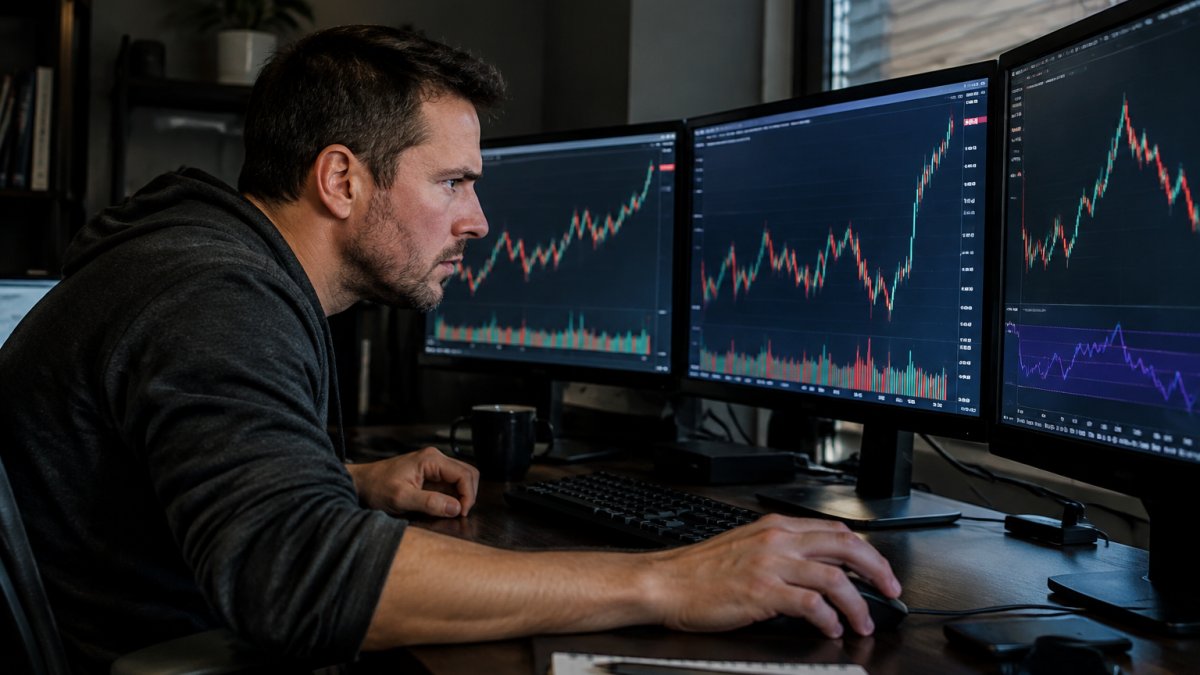
Traders often repeat the same pattern: price breaks out, they chase, then they sit through the pullback. The entry looks bold.
Here is the tell. A planned entry has a level, a size, and an exit before the click. A FOMO entry has only a feeling.
The Psychological Triggers Behind Chasing Entries
Chasing entries starts with a trigger, not a chart pattern. The four we see most often are regret, social proof, recency bias, and the fear of being left behind.
- Regret: You missed the last move and refuse to miss this one.
- Social proof: Someone online posts a winner and your discipline weakens.
- Recency bias: Three green days convince you the trend cannot end.
- Loss of identity: Sitting flat feels like failing.
Probability thinking is the antidote. Not every move is yours to take. If you want a deeper grounding in that mindset, our guide on mastering probability in stock market trading explains how to think in distributions instead of single outcomes.
Trading Psychology Tips That Actually Change Behavior
Most trading psychology tips fail because they target thoughts, not actions. Telling yourself to “stay disciplined” does nothing when a candle is ripping and your hand is already on the mouse. Behavior changes more reliably when you change what you are able to do in the moment, such as moving the decision into your platform settings.
Use platform-level guardrails, not willpower
Many trading platforms offer limits you can set before the session opens. These guardrails can help limit FOMO entries:
- Hard stop-loss orders attached at entry. In MT5, attach a stop-loss to the order before you click buy, not after. A stop that exists only in your head is not a stop; it is a hope. The platform will close the position whether you are watching or not.
- Daily loss limit. Where your broker or platform supports it, set a maximum daily drawdown. If it does not, set a manual rule and pair it with an alert at a chosen percentage of the limit so you get a warning in advance.
- Trade-count caps. Some platforms and third-party tools let you cap the number of orders per session.
- Price alerts instead of open charts. Set an alert at your no-chase level and at your planned entry. Close the chart. The alert, not your eyes, decides when you look. This removes the visual trigger that produces chasing.
- One-click trading off. Consider disabling one-click execution so an extra confirmation step sits between the impulse and the fill.
Some traders find it more effective to stop trying to feel less fear and instead set rules that limit fear’s influence. The platform can enforce the rule once it is set.
Change one behavior at a time
A common mistake is trying to fix five habits at once. Pick one. Removing a single trigger at a time and letting the platform carry the enforcement is one approach many traders use.
Try this sequence over four weeks:
- Week 1: Attach a hard stop-loss to every order at entry. No exceptions.
- Week 2: Add a daily loss limit and a platform alert at 80% of it.
- Week 3: Set a trade-count cap and turn off one-click trading.
- Week 4: Replace open charts with price alerts at your no-chase level.
Each step is a physical change to your setup, not a mental resolution. That is why it holds.
Watch out: platform guardrails work best when you set them before the session and avoid disabling them mid-trade.
If you want a deeper grounding in the mindset behind this, our guide on mastering probability in stock market trading explains how to think in distributions instead of single outcomes.
The article suggests rolling out these platform-level guardrails one per week over four weeks.
| Week | What to do |
|---|---|
| Week 1 | Attach a hard stop-loss to every order at entry |
| Week 2 | Add a daily loss limit and an alert at 80% of it |
| Week 3 | Set a trade-count cap and turn off one-click trading |
| Week 4 | Replace open charts with price alerts at your no-chase level |
Build a Pre-Market Trading Plan Template That Blocks Impulse Trades
A trading plan template works when it is short enough to read in two minutes, specific enough to remove choices, and wired into your platform so the plan executes even when your discipline does not. Vague plans invite impulse trading. Plans that live only on paper invite the same thing.
Use this structure before every market session, and set each field as a platform input, not just a note:
- Bias: Which direction am I trading today, and why? Write one sentence. If you cannot, you have no bias and should not trade.
- Levels: My entry, stop-loss, and profit target for each setup. Enter these as pending orders or alerts before the open.
- No-chase zone: The price above which I will not buy, no matter what. Set a price alert at this level so the platform tells you when the zone is breached.
- Max trades: My hard cap for the session. Set it as a platform limit or a visible counter on your desk.
- Max loss: The account drawdown that ends my day. Set a platform alert at 80% of this number.
- One rule I will not break today: Name it out loud and write it at the top of the plan.
The no-chase zone is a piece many traders skip. It converts a feeling into a number, and setting an alert at that level can remind you before you act.
Add a two-minute physiological pre-market routine
Plan templates often stop at the fields. The body can influence how a trade is set up before the chart is viewed. Physical arousal such as a fast heart rate and shallow breathing can narrow attention. Consider adding the following to the plan, before the first chart opens:
- Box breathing: Inhale for four counts, hold for four, exhale for four, hold for four. Repeat five times.
- Physiological sigh: Two quick inhales through the nose, then one long exhale. Do it three times.
- Stand and walk: Two minutes away from the screen resets focus and lowers arousal.
- Jaw and shoulder release: Unclench, drop the shoulders, and breathe out slowly.
Timing matters. Doing this before the session, rather than after a loss, can help you respect the no-chase zone.
Wire the plan into the platform
A plan that stays on paper is a wish. Before the open, do three things in your platform:
- Enter your entry, stop, and target as pending orders or alerts.
- Set the daily loss alert and the trade-count cap.
- Close every chart that is not on your plan. If a symbol is not in the plan, it does not get a window.
That last step matters more than it sounds. The chart you leave open is the chart you will trade. Remove the visual trigger and the impulse has nowhere to land.
Watch out: rewriting a plan mid-session can undermine it. Adjusting the no-chase zone after price has passed it moves away from the original plan.
If you want a full walkthrough for building the routine around this plan, our guide on building a disciplined trading routine covers it step by step.
Automated Trading Systems Benefits for Emotional Discipline
Automated trading systems can reduce the moment where fear influences a decision, since they execute the rules you set. Emotional discipline can become a property of your setup rather than a daily test of willpower.
Automation can also support:
- Consistent position sizing on every trade
- Stop-loss orders placed at entry
- Fewer unplanned trades during volatile sessions
For a closer look at how automation supports discipline, read our breakdown of the benefits of automated trading in MT5.
Physiological Regulation: Calming the Body Before the Next Entry
Physical stress signals such as a fast heart rate and shallow breathing can narrow attention, which may contribute to chasing entries.
Regulate the body first. These take under two minutes:
-
Box breathing: Inhale for four counts, hold for four, exhale for four, hold for four. Repeat five times.
-
Physiological sigh: Two quick inhales through the nose, then one long exhale. Do it three times.
-
Stand and walk: Two minutes away from the screen resets your focus.
-
Jaw and shoulder release: Unclench, drop the shoulders, and breathe out slowly.
Timing matters. Doing this before the entry, rather than after a loss, can help you respect the no-chase zone.
Post-FOMO Recovery: Resetting After a Chasing Loss
Recovery after a chasing loss is a protocol, not a mood. The danger is revenge trading, where one bad entry becomes three.
Run this sequence:
- Stop trading for the session. Close the platform.
- Log the trade. Entry, exit, size, and the emotion you felt at the click.
- Name the trigger. Regret, social proof, or boredom?
- Check your capital preservation rules. Did the loss stay inside your max loss?
- Return tomorrow with one rule tightened. Not five. One.
The psychological fallout of a bad fill runs deeper than the dollar loss. Our article on the psychological impact of high slippage trading explains why a worse-than-expected exit stings more than the number suggests, and how to reset from it.
Set Up Your Guardrails with EZMT5
Guardrails are the rules that hold when your discipline does not.
A pre-built system can execute your entry and exit rules, which may reduce the role of manual chasing decisions.
Watch out: automation does not remove risk. A system still needs position sizing and a max loss you respect.
If you are ready to put the rules in the platform instead of your willpower, our guide on automating risk management in MT5 shows the exact setup.
Fear of missing out does not disappear because you read about it.
Frequently Asked Questions
How do I overcome fear of missing out in trading?
Start by defining your trade setups before the market opens and writing down the exact price levels you will accept. When a move happens outside those levels, treat it as information, not an invitation. Pair that with position sizing rules that cap your risk per trade, and use a trading journal to record every entry you skipped and why. Over time the data shows you that missed moves rarely cost as much as chased ones. Automated systems can also enforce entry rules when your emotions push back.
What are the psychological triggers of FOMO in financial markets?
The main triggers are social media posts showing other traders’ wins, sudden market volatility that creates a sense of urgency, and the pain of watching a stock or currency pair run without you. Loss aversion makes that missed opportunity feel like a real loss, which pushes traders to chase entries at worse prices. Mental fatigue and a lack of a written trading plan make these triggers harder to resist, especially during high-volume market sessions.
How does automated trading help reduce emotional decision-making?
Automated trading systems execute entries and exits based on predefined rules, so they remove the moment where fear or excitement overrides your plan. Stop-loss orders and profit targets are placed at the same time as the trade, which limits the damage from impulse trading. EZMT5 provides fully built MT5 systems and TradingView indicators that can run predefined rules for you.
What is the difference between a high-probability trade and a FOMO trade?
A high-probability trade comes from a tested setup with defined entry, stop-loss, and profit target levels, often confirmed by technical analysis and price action. A FOMO trade happens after the move is already underway, usually with no plan and a wider stop. The practical test is simple: if you cannot state your risk in dollars and your exit before you click buy, it is a FOMO trade. Writing that rule into your trading plan template makes the difference visible in real time.
