

Table of Contents
- What Makes Automated Risk Management Different for Scalpers
- Scalping Risk Management Best Practices and Why Speed Matters
- How to Automate Stop Loss Orders Without Sacrificing Control
- Automated Trading Risk Management Software: Cost vs. Benefit
- Fail-Safes and Kill Switches: The Safety Layer Automation Adds
- The Human-in-the-Loop Hybrid Model for Scalpers
- Is It Worth It? The Real Financial Case for Automation
Last Updated: August 9, 2026
What Makes Automated Risk Management Different for Scalpers
Automated risk management for scalping operates in a fundamentally different timeframe than traditional trading risk controls. While a swing trader adjusts positions over hours or days, a scalper executes dozens of trades per day where manual intervention becomes impossible. The speed advantage of automation isn’t just convenient; it’s the difference between capturing a profitable 5-tick move and watching it evaporate.
Automated risk management is the use of pre-programmed rules and algorithms to enforce position sizing, stop-loss placement, and profit-taking without human intervention. For scalpers, this means the system enforces your risk-per-trade calculation instantly, adjusts stops based on volatility, and closes positions when predetermined conditions are met. A properly configured automated system responds to market conditions in milliseconds, while a human trader responds in seconds to minutes.
What makes this different for scalping is the volume-to-profit ratio. A scalper targeting 2-5 ticks per trade on a 1-minute or 5-minute chart needs mechanical precision. One missed stop-loss on a volatile move can wipe out the profit from 10 successful trades. For serious scalpers, automated risk management isn’t optional, it’s foundational to whether the strategy works at all.
Scalping Risk Management Best Practices and Why Speed Matters
Scalping risk management demands defining your maximum loss before you enter the trade, and that definition must be automated, not discretionary. On a 1-minute chart with high volatility, the difference between a stop-loss executing at your intended level versus 3-5 ticks worse can swing your session from profitable to breakeven.
The first best practice is position sizing based on account risk, not fixed lot sizes. If your account is $25,000 and you’re risking 1% per trade, that’s $250 maximum loss per trade. Automated systems enforce this on every single trade, while manual traders often skip this step or do it inconsistently.
The second practice is volatility-adjusted stop placement. The Average True Range (ATR) at 9:30 AM ET differs from 2:00 PM ET. Automated systems can recalculate stops based on current volatility metrics and adjust position size accordingly, preventing stops that are too tight or too wide.
The third practice is automated take-profit levels tied to risk-reward ratios. A 1:2 risk-reward ratio means if you’re risking $250, you’re targeting $500 profit. That target price can be calculated automatically and an order placed instantly. Without automation, traders often move stops too early, trail stops inconsistently, or hold winners too long.
Speed matters because slippage costs money. On a scalp targeting 3 ticks, a 1-tick slippage is 33% of your profit. Automated execution eliminates the delay between decision and order placement and removes the temptation to hold losing trades or close winners too early.
The scalper who executes the same strategy consistently across 50 trades per day will outperform the scalper who executes manually and inconsistently across 10 trades per day. Automation enables the consistency that makes scalping work.
How to Automate Stop Loss Orders Without Sacrificing Control
Automating stop-loss orders doesn’t mean handing your account to a robot. Effective automation maintains human oversight while removing the emotional element of stop execution.
Step 1: Define your stop-loss rule in writing before you trade. Write down: "On 5-minute charts, my stop is 20 pips below entry on EUR/USD. On 1-minute charts, my stop is 12 pips below entry." This removes decision-making in real time.
Step 2: Set your stop-loss as a pending order immediately upon entry. In MT5, place your entry and stop-loss simultaneously. Don’t enter manually and then add the stop later; that delay is where mistakes happen.
Step 3: Use alerts for the first 10-15 trades. Configure your system to send notifications when a stop-loss is about to execute. This lets you observe the system working and catch configuration errors before they cost real money.
Step 4: Build in a kill switch. This is non-negotiable. A kill switch is a manual override that closes all open positions immediately. If something is wrong, you can press one button and exit everything.
Step 5: Set maximum daily loss limits and maximum concurrent positions. Configure hard limits: "Stop trading after 3 consecutive losses" or "Never hold more than 4 concurrent positions." When these limits are hit, the system stops entering new trades.
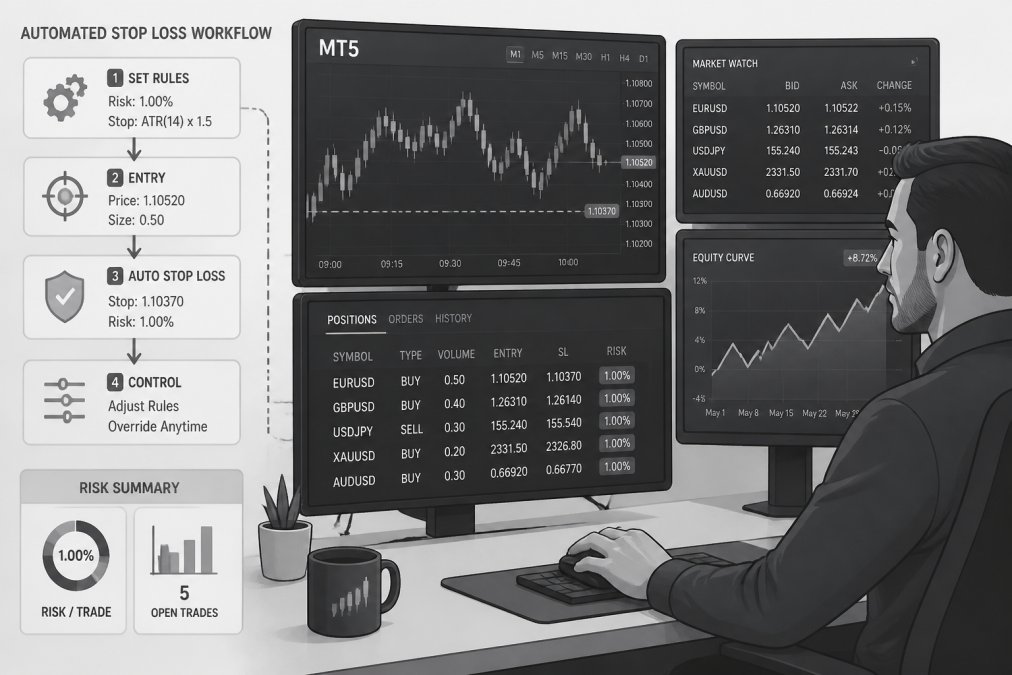
Start with alerts and observation. Move to full automation only after confirming the system works exactly as designed. This approach gives you the speed advantage of automation while maintaining control that prevents catastrophic errors.
A common mistake is setting your stop-loss too tight to “preserve capital.” A 5-pip stop on a volatile pair will trigger on normal price noise, exiting winners prematurely. This erodes your edge more than the occasional larger loss would. Test your stop-loss width in backtesting before automating it.
Automated Trading Risk Management Software: Cost vs. Benefit
The cost-benefit analysis for automated risk management software has two components: the direct cost of the software and the opportunity cost of your time.
Direct costs vary widely. Some platforms like MT5 have built-in automation that’s free. Others require purchasing third-party software or paying for advanced features. Professional-grade automated trading systems range from free tools with basic features to subscription-based platforms costing a monthly fee.
The benefit side is more significant. A scalper executing 50 trades per day manually spends roughly 2-3 hours per day on execution and monitoring. Automated execution reduces that to 30 minutes per week for monitoring. If you value your time at $50/hour, that’s $475-$725 per week of time freed up, or $24,700-$37,700 per year.
More importantly, automation increases consistency. If automation increases your average profit per trade by just $5 across 50 daily trades, that’s $250 per day, or $65,000 per year (assuming 260 trading days). Most professional-grade software costs less than this.
Budget 20-40 hours of setup time. If you’re losing trading income while you learn, that’s a real cost that should factor into your decision.
Calculate your break-even point: (Software cost + Setup time cost) ÷ (Profit per trade × Trades per day × Trading days per year). If that number is less than your current average profit per trade, automation pays for itself immediately. Most serious scalpers find this number is positive within the first 2-3 months.
Fail-Safes and Kill Switches: The Safety Layer Automation Adds
Removing human emotion from execution creates new risks. A human trader would never accidentally place 100 contracts instead of 1. An automated system with a configuration error will do exactly that, in milliseconds, across 50 trades before you notice.
A kill switch is a single command that closes all open positions immediately. In MT5, this can be a hotkey or a button in your trading platform. You can execute it without thinking, in less than one second, from anywhere.
Fail-safes are automated rules that stop the system from trading under certain conditions. Examples include: "Stop all trading if the daily loss exceeds 2% of account equity," "Close all positions if volatility exceeds 2 standard deviations above normal," or "Halt new entries if the system has closed 3 consecutive losing trades."
The most effective fail-safes are layered:
- Per-trade fail-safe: Maximum loss per individual trade (your stop-loss)
- Daily fail-safe: Maximum loss per trading day
- Drawdown fail-safe: Maximum decline from account peak
- Volatility fail-safe: Stop trading if market conditions exceed defined parameters
- Execution fail-safe: Reject orders if they violate position-sizing rules
Without these layers, a single glitch can wipe out weeks of profits. With them, the worst-case scenario is one bad trade, not account destruction.
The Human-in-the-Loop Hybrid Model for Scalpers
The most practical approach for most scalpers is a hybrid model where automation handles execution and risk management, but humans retain decision-making authority over market conditions and strategy selection.
You define 2-3 different scalping strategies (e.g., breakout scalp, mean-reversion scalp, trend-following scalp). Each strategy has its own set of automated rules, stop-losses, and take-profit levels. You monitor the market and decide which strategy to activate based on current conditions. The automated system then executes that strategy consistently until you deactivate it.
This approach captures the benefits of automation (speed, consistency, risk enforcement) while maintaining human judgment about when a strategy should be active. A scalper might notice that mean-reversion works well in range-bound markets but fails in trending markets. Instead of forcing the system to trade anyway, they simply activate the trend-following strategy instead.
The hybrid model also reduces the psychological friction that stops traders from trusting automation. Instead of "handing your account to a robot," you’re making strategic decisions while the system handles tactical execution.
Is It Worth It? The Real Financial Case for Automation
The honest answer depends on three variables: your trading frequency, your current win rate, and your time value.
If you’re executing fewer than 10 trades per day, automation probably isn’t worth the setup effort. If you’re executing 30+ trades per day, automation becomes increasingly valuable because the time savings compound and the consistency gains matter more.
Your current win rate determines whether automation helps or hurts. If you’re already profitable and consistent, automation preserves that edge while freeing your time. If you’re breakeven or losing, automation won’t fix that; it will just make you lose money faster and more consistently.
The time value calculation is straightforward. If you’re spending 3 hours per day on execution and monitoring, and you could automate that to 20 minutes, you’re freeing up 2.5 hours daily. If that time has value to you, automation pays for itself quickly.

The most important factor is this: automated risk management only works if you trust it. That trust comes from testing, observation, and gradual implementation. A trader who spends two weeks setting up automation, testing it on a demo account, then deploying it cautiously will likely succeed.
The financial case for automation is strongest when you combine it with systems that are already proven. Rather than building custom automation from scratch, using pre-built systems with integrated risk management reduces the setup time and increases the likelihood that you’ll actually use the automation consistently.
For serious scalpers, the question isn’t whether automation is worth it. It’s whether you can afford not to automate. The traders who execute manually are giving up speed, consistency, and time. The traders who automate properly are capturing an edge that manual execution can’t match.
Scalping without automated risk management is like building a house without a foundation. You might get lucky with a few good trades, but the inconsistency will eventually catch up.
If you’re serious about scalping, start with a system that already has automation built in. EZMT5 provides 11 fully built and optimized MT5 trading systems that come with integrated risk management, stop-loss automation, and position-sizing rules already configured. You download the system, adjust it to your account size and risk tolerance, and activate it. The automation infrastructure is already there.
The flexibility of two license keys per system means you can test one strategy on a demo account while running another on your live account. You can swap between systems based on market conditions without losing your risk management setup.
Start with one system, test it thoroughly, then add more as your confidence grows. That’s the path to sustainable automated scalping.
Frequently Asked Questions
Can scalping be automated without losing control over individual trades?
Yes, but it requires the right setup. Automated risk management handles execution speed and stop-loss placement faster than manual intervention, while you retain control through pre-set parameters and kill switches. A human-in-the-loop hybrid model lets you set entry rules and risk limits, then let automation execute and protect positions. The key is backtesting your automated rules thoroughly before live trading and monitoring the system's performance regularly.
What's the real cost difference between automated risk management and managing stops manually?
Automated systems eliminate slippage from manual delays, reduce emotional decision-making, and handle multiple positions simultaneously. Manual management costs you in missed exits, wider spreads due to slower execution, and account drawdown from psychology-driven errors. Software subscriptions add recurring expense, but the edge gained from consistent, faster execution typically offsets this for active scalpers. Calculate your average cost per trade (commissions plus slippage) against the software fee to find your break-even point.
How do automated fail-safes protect your account if something goes wrong?
Kill switches are hardcoded rules that halt all trading if specific conditions trigger: account equity drops below a threshold, slippage exceeds acceptable limits, or execution latency spikes. This prevents cascading losses during market gaps or system errors. Automated trading risk management software also enforces position-sizing rules and maximum daily loss limits that manual traders often override under pressure. The safety layer is especially critical for scalping, where rapid position turnover can amplify losses quickly if left unchecked.
Does automated risk management actually reduce slippage in scalping?
Yes, because automation eliminates the delay between your decision and execution. Scalping profits depend on tight spreads and quick exits; every millisecond of latency costs you. Automated systems execute instantly when conditions are met, whereas manual traders face reaction time and order-placement delays. However, slippage also depends on market liquidity and your broker's execution quality. Automation maximizes your control over the execution window, but cannot eliminate market-wide slippage during low-liquidity periods.
This article was written using GrandRanker