

Table of Contents
- Rule 1: Apply the 1% Rule to Protect Your Account
- Rule 2: Master Day Trading Position Sizing
- Rule 3: Implement Day Trading Stop-Loss Strategies
- Rule 4: Optimize Your Risk-to-Reward Ratio for Day Trading
- Rule 5: Set Daily Maximum Loss Limits
- Rule 6: Develop Day Trading Psychology and Risk Management Discipline
- Rule 7: Manage Leverage and Market Exposure Carefully
- Implementing These 7 Rules: A Practical Checklist
7 Risk Management Rules for Day Trading
Last Updated: July 24, 2026
Understanding the 7 risk management rules for day trading separates traders who preserve capital from those who blow up accounts. A trader managing risk properly can survive losing streaks that would wipe out undisciplined peers. At EZMT5, we’ve analyzed thousands of day trading accounts, and the pattern is consistent: the winners follow rules, the losers ignore them. This guide covers the exact framework that professional traders use to protect their accounts while capturing market opportunities.
Risk management comes first. Position sizing, stop-loss placement, daily loss limits, and leverage control aren’t boring prerequisites, they’re the foundation that lets you trade with confidence instead of fear.
Rule 1: Apply the 1% Rule to Protect Your Account
The 1% rule is the simplest and most powerful risk management concept in day trading: risk no more than 1% of your total account equity on a single trade. If your account is $10,000, you risk $100 per trade maximum. If your account is $500, you risk $5.
This single rule prevents catastrophic loss. A string of 10 losing trades at 1% risk leaves your account at 90% of starting value. The same 10 losses at 5% risk per trade drops your account to 60%, requiring 67% gains just to break even.
The 1% rule assumes you’re calculating risk from your current account balance, not your starting balance. As your account grows, your dollar risk per trade grows with it, creating a natural compounding effect that accelerates gains during winning periods without exposing you to ruin during drawdowns.
How to Calculate Your 1% Risk
The formula is straightforward: Account Balance × 0.01 = Maximum Risk per Trade.
For a $2,000 account: $2,000 × 0.01 = $20 maximum risk per trade.
Once you know your maximum risk in dollars, use that figure to determine your position size. Your stop-loss distance from entry determines how many shares you can buy. If you’re risking $20 and your stop-loss is 50 cents away from entry, you can buy 40 shares ($20 ÷ $0.50 = 40 shares).
This inverse relationship between stop-loss distance and position size keeps risk constant regardless of volatility.
Why 1% Works for Small Accounts ($500-$2k)
Small accounts benefit most from strict risk discipline because recovery from losses is harder. With $500 and 1% risk, you can take 100 losing trades in a row before depletion.
Rule 2: Master Day Trading Position Sizing
Position sizing is the mechanism that enforces your risk rule. It answers: "How many shares do I buy on this trade?" Professional traders calculate position size before entering a trade. Amateur traders enter a position, then decide where to stop out. The order matters enormously.
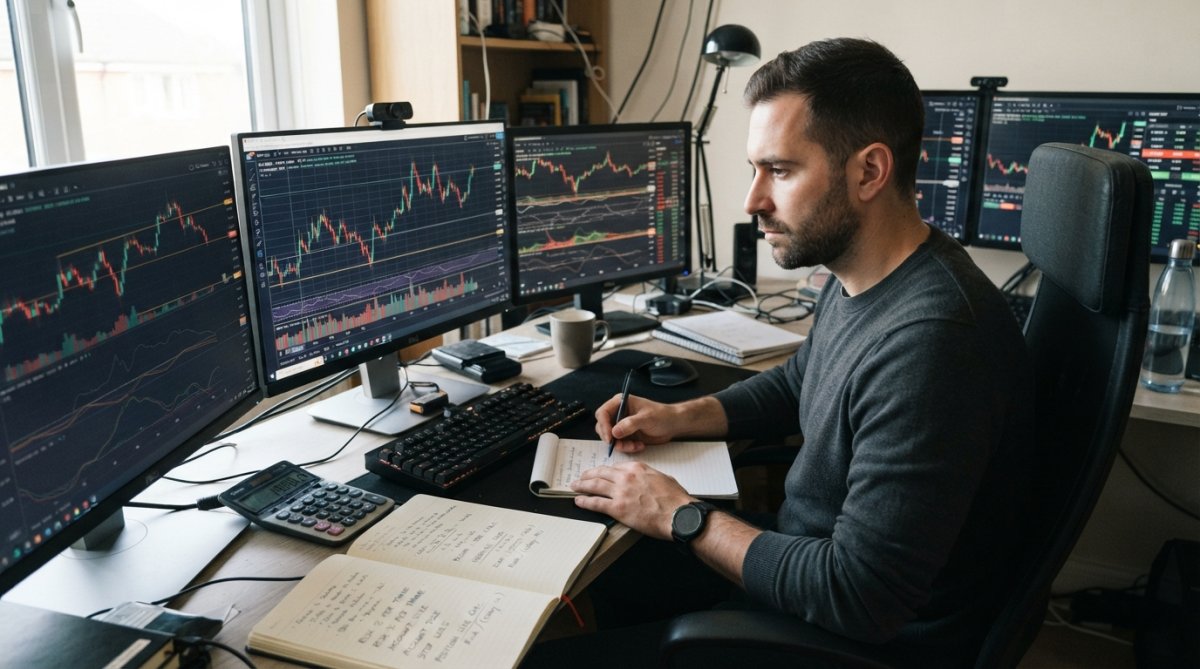
Position Sizing Formula and Tools
The standard formula is:
Position Size = (Account Risk in Dollars) ÷ (Stop-Loss Distance in Dollars)
Example: $10,000 account, 1% risk rule, $2 stop-loss distance.
- Risk per trade: $10,000 × 0.01 = $100
- Position size: $100 ÷ $2 = 50 shares
If you buy 50 shares and your stop-loss triggers at $2 below entry, you lose exactly $100.
The TrendSpider Position Size Calculator eliminates manual math.
Position sizing is the only variable you control completely. You can’t control whether a trade wins or loses. You can’t control market volatility. You can control exactly how many shares you buy. Protect that control fiercely.
Adjusting Position Size for Volatility
Volatility changes position sizing math in real time. High-volatility stocks require wider stop-losses, which shrink position size. Low-volatility stocks allow tighter stops, which increase position size.
A stock with Average True Range (ATR) of $3 is more volatile than a stock with ATR of $0.50. If you’re using ATR-based stops, your stop-loss distance scales with volatility. This automatic adjustment prevents you from overexposing yourself to volatile stocks.
Rule 3: Implement Day Trading Stop-Loss Strategies
A stop-loss order is an instruction to exit a losing trade at a predetermined price. Without a stop-loss, your maximum loss is unlimited. With a stop-loss, your maximum loss on any trade is fixed. The psychological value of a stop-loss exceeds its mechanical value: knowing your loss is capped at $100 allows you to think clearly.
Stop-Loss Order Types and Placement
A standard stop-loss is a market order that executes when price touches your stop price. If you buy at $50 and place a stop-loss at $48, your order activates when price falls to $48. In fast-moving markets, you might fill at $47.95, slippage that reduces your actual loss.
A stop-limit order adds a limit price. The order activates at $48 but only fills if price is $47.50 or better. The advantage is precision; the disadvantage is that you might not fill at all if price gaps through your limit.
For day traders, standard stop-loss orders (market orders) are preferable. You prioritize getting out over getting a perfect price. Place your stop just outside support/resistance levels, outside technical patterns, or 1.5 to 2 ATR units away from entry.
Bracket Orders for Automated Risk Control
A bracket order combines three orders: an entry order, a take-profit order, and a stop-loss order. You submit all three simultaneously. When the entry fills, the profit target and stop-loss activate. When either fills, the other cancels.
Bracket orders automate the exit decision, removing emotion from the two moments when traders make the worst decisions. Most brokers support bracket orders. Interactive Brokers Trader Workstation offers advanced bracket functionality. NinjaTrader’s account-level risk settings include automated profit-target and drawdown locks that prevent trades from opening if you’ve hit daily loss limits.
Bracket orders are powerful but dangerous if misused. If you set a profit target that’s unrealistic, you’ll rarely hit the target and will exit with small losses repeatedly. Match your profit target to the stock’s typical range and your entry method’s edge.
Rule 4: Optimize Your Risk-to-Reward Ratio for Day Trading
The risk-to-reward ratio compares your maximum loss to your potential profit on a single trade. A 1:2 ratio means you risk $100 to make $200. Day trading risk-to-reward ratios are tighter than swing trading because intraday moves are smaller, typically targeting 1:1.5 to 1:2 ratios.
Calculating and Maintaining Minimum Ratios
Calculate your risk-to-reward ratio before entering a trade. Risk is fixed (your stop-loss distance × position size). Profit target is your exit plan.
Example: You buy at $50 with a $48 stop-loss (risk = $2) and a $52 profit target (reward = $2). Your ratio is 1:1, profitable if you win 50% of trades.
Example: You buy at $50 with a $48 stop-loss (risk = $2) and a $53 profit target (reward = $3). Your ratio is 1:1.5, profitable if you win 40% of trades.
Most professional day traders maintain a minimum 1:1.5 ratio to account for slippage, commissions, and the reality that actual win rates are lower than backtested win rates.
Rule 5: Set Daily Maximum Loss Limits
A daily maximum loss limit is the total amount you allow your account to lose in a single trading day. Once you hit that limit, you stop trading. No exceptions.
Daily loss limits prevent emotional revenge trading. After a big loss, traders often increase position size and take lower-probability trades to "make back" the loss, compounding damage. A daily limit prevents this spiral.
Defining Your Daily Drawdown Threshold
Set your daily loss limit as a percentage of account equity. Common limits are 2%, 3%, or 5% of daily starting balance.
For a $10,000 account with a 2% daily limit: $10,000 × 0.02 = $200 maximum daily loss.
Once you hit your daily limit, close your trading platform or step away from the desk.
Set your daily loss limit before market open, not after a losing trade. Deciding the limit while you’re calm, then following it mechanically, prevents rationalizing a higher limit after losses.
Automated Risk Management Tools for Real-Time Monitoring
Manual tracking of daily losses is error-prone. TraderSync’s real-time risk monitoring dashboard imports trades directly from your broker and displays daily P&L, risk metrics, and drawdown percentages. TradesViz’s AI-powered trade analysis offers similar functionality with Monte Carlo simulations and historical drawdown analysis. For traders using EZMT5’s automated systems, the platform includes built-in daily loss monitoring that can halt trading when your daily limit is reached.
Rule 6: Develop Day Trading Psychology and Risk Management Discipline
Technical skill accounts for perhaps 30% of trading success. Psychology and discipline account for the remaining 70%. You can have perfect entry signals, but if you override them with emotional decisions, you lose money.
The most common emotional override is revenge trading. After a loss, your brain demands immediate compensation. You take the next trade with a larger position, wider stop, or lower probability setup. Losses compound.
Avoiding Revenge Trading and Emotional Decisions
The solution is mechanical: after a loss, reduce position size on the next trade. If you normally risk $100 per trade, risk $50 after a loss. This forces you to slow down and think, preventing the escalation that turns a $100 loss into a $500 loss.
Some traders implement a "three-loss rule": after three consecutive losses, they stop trading for the rest of the day. Others use a time-based approach: after a significant loss, they wait 15 minutes before taking another trade.
Using Trading Journals for Post-Trade Risk Review
A trading journal documents every trade: entry price, exit price, reason for entry, reason for exit, profit/loss, and notes on your emotional state. Over time, patterns emerge showing where your discipline breaks down.
TradesViz’s journaling with AI summaries automatically categorizes trades and highlights patterns. You can filter by entry method, time of day, market condition, or emotional state, then see your win rate for each category. Review your journal weekly to reveal true patterns rather than over-optimize.
Rule 7: Manage Leverage and Market Exposure Carefully
Leverage amplifies both gains and losses. A 2:1 leverage magnifies a 1% gain to 2%, but magnifies a 1% loss to -2%. Day traders have access to leverage through margin accounts, which allow them to control more capital than they have deposited.
In the United States, day traders with accounts under $25,000 face Pattern Day Trader (PDT) rules that limit leverage to 4:1 on equities. Many profitable day traders use no leverage at all, trading with 1:1 leverage (cash account), which eliminates margin calls and forces discipline.
Understanding Margin Requirements and Leverage Limits
Margin requirement is the percentage of a position’s value you must deposit to control it. A 50% margin requirement means you can control $2 in securities with $1 in cash.
If you use leverage and your account drops below the margin requirement, your broker issues a margin call. You must deposit additional cash or your broker liquidates positions, often at the worst time. The safest approach is to use minimal leverage, 1:1 or 2:1 maximum, which keeps margin calls unlikely and forces selectivity.
Risk Management During High-Impact News Events
High-impact economic data creates volatile price spikes. Spreads widen. Stop-losses slip. Volatility explodes. Many professional day traders reduce position size or stop trading entirely during these events.
If you do trade during news events, reduce position size by 50% or more. Your normal 1% risk per trade becomes 0.5% risk. Alternatively, set your stop-losses wider during news events while maintaining your dollar risk through reduced position size.
Implementing These 7 Rules: A Practical Checklist
| Risk Management Rule | Implementation Step | Frequency | Check |
|---|---|---|---|
| 1% Rule | Calculate max risk per trade (1% of account) | Before every trade | ☐ |
| Position Sizing | Use formula: Risk ÷ Stop Distance = Shares | Before every trade | ☐ |
| Stop-Loss | Place order at predetermined level, use bracket orders | Before every trade | ☐ |
| Risk-to-Reward | Verify minimum 1:1.5 ratio before entry | Before every trade | ☐ |
| Daily Loss Limit | Set percentage limit, stop trading when hit | Daily at market open | ☐ |
| Trading Journal | Log every trade with entry, exit, emotion | After market close | ☐ |
| Leverage & News | Reduce position size 50% during high-impact events | During news events | ☐ |
The 7 risk management rules for day trading work best as an integrated system. The 1% rule sets your maximum per-trade risk. Position sizing converts that into shares. Stop-losses enforce the position size. Daily loss limits prevent emotional escalation. Risk-to-reward ratios ensure profitable edge. Trading journals reveal patterns. Leverage management adapts to market conditions.
Missing any one of these creates a gap. Implement all seven. Track them in a checklist. Review your checklist before every trade. After 30 days of consistent application, these rules stop feeling like restrictions and start feeling like protection.
The difference between traders who survive and traders who fail comes down to discipline. Markets reward those who follow rules and punish those who break them. The 7 risk management rules for day trading are your insurance policy. EZMT5’s automated trading systems include built-in position sizing, daily loss limits, and bracket order execution that enforce these rules mechanically. You set your risk parameters once, and the system maintains discipline across every trade. Start trading with rules in place, not after you’ve learned them through losses.
Frequently Asked Questions
What is the 1% rule in risk management for day trading?
The 1% rule means risking no more than 1% of your total account equity on a single trade. For example, if you have a $10,000 account, you risk a maximum of $100 per trade. This rule protects your capital from catastrophic loss and ensures you can survive a losing streak. It's especially critical for small accounts ($500-$2k) where a few large losses can eliminate your trading capital entirely.
How do I calculate position size using the risk-to-reward ratio for day trading?
Determine your entry price, stop-loss level, and target exit price. Calculate the distance from entry to stop-loss (your risk) and entry to target (your reward). Position size is calculated as: (1% of account equity) ÷ (risk per share in dollars). For example, with a $5,000 account risking $50, and a $0.50 stop-loss distance, you'd trade 100 shares. Maintain a minimum 1:2 risk-to-reward ratio to ensure profitable trades offset losses.
What are the best stop-loss strategies for day traders?
Use bracket orders (entry with simultaneous stop-loss and take-profit orders) for automated execution. Place stop-losses at technical support/resistance levels or use volatility-based stops (e.g., Average True Range). Never move a stop-loss against your position (wider). Set stops before entering the trade to avoid emotional decisions. Combine stops with daily loss limits, if you hit your daily max loss, stop trading for the day to prevent revenge trading.
How can I improve my day trading psychology and avoid revenge trading?
Maintain a trading journal to review every trade's setup, execution, and outcome objectively. Set daily maximum loss limits and enforce them strictly, once hit, walk away. Use automated trading systems (like EZMT5's fully built systems) to remove emotion from entry and exit decisions. Practice trading discipline through simulated trading before risking real capital. Recognize that losses are part of the game; accept them and move to the next setup rather than chasing losses.
What automated risk management tools can help me monitor day trading risk in real time?
Platforms like TraderSync offer real-time portfolio heat maps and AI-powered risk pattern detection. NinjaTrader provides account-level risk settings (daily profit-target or drawdown locks). Trading journals like TradesViz and JournalPlus integrate risk analytics directly into your workflow, tracking drawdowns and position sizing insights. EZMT5's automated MT5 trading systems execute entries and exits with precision, removing manual execution risk. Position size calculators like TrendSpider's free tool help enforce consistent risk per trade before you enter.
This article was written using GrandRanker