

Table of Contents
- Why Trading Mindset Books Matter for Your Success
- Quick Comparison: The 5 Best Trading Mindset Books
- 1. Trading in the Zone: Master Probability and Discipline
- 2. The Daily Trading Coach: Actionable Exercises for Emotional Control
- How to Manage Fear and Greed in Trading
- 3. Atomic Habits: Building Trading Routines That Stick
- 4. Market Wizards: Lessons from Top Traders
- 5. Thinking, Fast and Slow: Understanding Cognitive Biases
Last Updated: August 22, 2026
Why Trading Mindset Books Matter for Your Success
Your trading strategy might be solid and your technical analysis flawless, but if your mind isn’t disciplined when the market moves against you, none of that matters. The gap between a profitable trader and one who loses money often comes down to mental discipline.
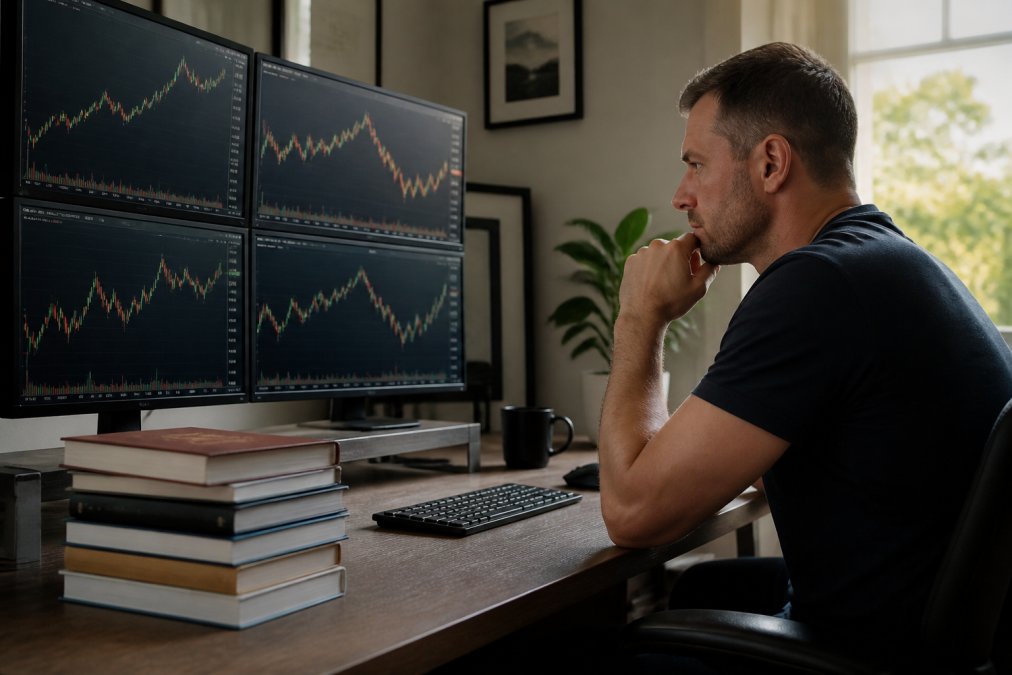
Trading psychology determines whether you stick to your plan or panic-sell at the worst moment. The best trading mindset books explain why your brain works against you in markets, show you how successful traders think, and give you practical exercises to rewire your decision-making.
Trading psychology isn’t a nice-to-have. It’s the foundation that determines whether your edge translates into actual profits or gets destroyed by emotional interference.
Quick Comparison: The 5 Best Trading Mindset Books
| Book | Author | Best For | Key Focus | Format |
|---|---|---|---|---|
| Trading in the Zone | Mark Douglas | Mastering probability & discipline | Mindset shift, emotional control | Foundational theory |
| The Daily Trading Coach | Brett Steenbarger | Practical daily exercises | Self-coaching routines | Actionable exercises |
| Atomic Habits | James Clear | Building consistent trading routines | Habit systems, identity-based change | General framework |
| Market Wizards | Jack D. Schwager | Learning from top traders | Real-world trader interviews | Case studies |
| Thinking, Fast and Slow | Daniel Kahneman | Understanding cognitive biases | Behavioral economics, decision science | Deep research |
1. Trading in the Zone: Master Probability and Discipline
Skip everything else if you only have time for one book. Trading in the Zone teaches you how to think like a trader who actually wins. Mark Douglas doesn’t teach a strategy; he teaches you to accept that markets are probabilistic, not certain. You can be right about direction and still lose money on position sizing. You can follow your plan perfectly and still hit a losing streak.
Douglas explains the five fundamental truths for high-performance trading and why traders abandon discipline in high-stress situations. The framework for probability thinking alone is worth the price. The most valuable insight: losing trades aren’t failures if they follow your plan. This mental shift separates consistent traders from those who self-sabotage by second-guessing themselves.
Best For: Traders who understand their strategy but can’t execute it consistently due to emotional interference.
Pros:
- Widely cited as the most influential trading psychology book
- Provides a framework for developing a probabilistic mindset that sticks
- Addresses the root cause of most trading problems
Cons:
- Heavy on theory, light on practical step-by-step exercises
- Requires active reflection to apply concepts
2. The Daily Trading Coach: Actionable Exercises for Emotional Control
If Trading in the Zone gave you the theory, The Daily Trading Coach gives you the toolkit. Dr. Brett Steenbarger organized this book as 101 practical lessons and self-coaching exercises designed for immediate implementation.
Each lesson is short enough to read in 5 minutes but deep enough to shift how you approach a specific trading problem. One day you’re managing fear during drawdowns; the next you’re building a routine to review your trading journal. The structure is ideal for busy traders, you don’t have to read cover-to-cover. Open it to whatever emotional challenge you’re facing and find a relevant exercise based on actual coaching sessions.
Best For: Traders seeking practical, exercise-based approaches to emotional management and daily mental routines.
Pros:
- Offers actionable advice and exercises for immediate implementation
- Covers many psychological challenges traders actually face
- Written by a seasoned trading coach with clinical psychology background
Cons:
- Requires consistent effort and discipline to apply exercises effectively
- Some readers prefer a more narrative approach
How to Manage Fear and Greed in Trading
Fear and greed destroy trading accounts. Fear makes you exit winning trades too early. Greed makes you hold losers hoping they’ll bounce back. Both are hardwired into your nervous system, they’re biology, not character flaws.
The key is managing these emotions before they manage you. Fear typically shows up as hesitation (apa.org). You see a setup that fits your plan but don’t pull the trigger because you’re afraid of being wrong. The solution isn’t to become fearless; it’s to separate the emotion from the decision. You execute because your plan says to execute, not because you feel confident.
Greed manifests as holding winners too long or adding to positions beyond your risk rules. The antidote is a predetermined exit plan. Before you enter any trade, know exactly where you’ll exit at profit. When that level hits, you close it.
The most dangerous moment is after a string of losses. Your brain wants to “make it back” quickly, which leads to oversized positions and revenge trading. Your plan should explicitly include position-sizing rules that prevent this.
3. Atomic Habits: Building Trading Routines That Stick
Atomic Habits isn’t a trading book, but its principles apply directly. James Clear’s framework, make habits obvious, attractive, easy, and satisfying, translates directly into building consistent trading routines.
Most traders fail because they rely on willpower, which is finite (peer-reviewed research). You can’t willpower your way through a drawdown. But you can build systems. Want to review your trading journal every evening? With willpower, you’ll do it for three days then stop. With Atomic Habits principles, you make it obvious (set a specific time), attractive (pair it with coffee), easy (use a template), and satisfying (track it visually). Suddenly it’s a habit, not a chore.
Best For: Traders who struggle with building consistent routines and maintaining discipline.
Pros:
- Provides a clear, actionable framework for habit change
- Principles are highly adaptable to trading discipline
- Focuses on systems rather than goals
Cons:
- Not trading-specific, requiring readers to apply concepts themselves
- Requires conscious effort to translate general habit principles into trading practices
4. Market Wizards: Lessons from Top Traders
Market Wizards is a series of interviews with some of the world’s most successful traders. Jack D. Schwager extracted the common threads that separate winners from everyone else. The book doesn’t teach a specific strategy; it shows you how successful traders actually think.
Most successful traders share three traits: they have a clear edge and understand it deeply, they manage risk obsessively with small losses and appropriately sized winners, and they’re emotionally disciplined. They don’t chase markets, revenge trade, or let ego interfere with their plan. One recurring theme: the most successful traders are comfortable being wrong. They take losses without ego, which allows them to stay disciplined and preserve capital.
Best For: Traders seeking inspiration and practical wisdom from experienced professionals.
Pros:
- Provides real-world perspectives from highly successful traders
- Emphasizes emotional control, adaptability, and meticulous planning
- Timeless lessons on market psychology remain relevant
Cons:
- Does not teach specific trading strategies directly
- Interview format may not appeal to all readers
5. Thinking, Fast and Slow: Understanding Cognitive Biases
Daniel Kahneman won a Nobel Prize for his research on behavioral economics (nobelprize.org). He describes two systems of thinking: System 1 is fast, intuitive, and emotional; System 2 is slow, deliberate, and logical. Most traders rely too heavily on System 1, which is prone to cognitive biases like anchoring on the wrong price or seeing patterns that don’t exist.
For traders, the key insight is that you can’t eliminate these biases through awareness alone. You have to design your trading process to account for them. Use checklists. Automate entries and exits. Rely on rules, not intuition.
Best For: Traders interested in understanding cognitive biases that affect their decisions.
Pros:
- Offers scientific, in-depth look at human cognition and decision-making
- Provides valuable tools for recognizing unhelpful patterns
- Highly acclaimed and influential
Cons:
- Not trading-specific, requiring readers to apply concepts themselves
- Can be dense and academic
Trading Psychology Books: Choosing the Right One for Your Level
For beginners: Start with Trading in the Zone. It builds the psychological foundation before you develop a strategy.
For intermediate traders: Add The Daily Trading Coach and Atomic Habits. You understand the concepts; now implement them consistently.
For experienced traders: Market Wizards and Thinking, Fast and Slow offer deeper insights to refine your edge.
For traders struggling with consistency: The Daily Trading Coach is your priority. The exercises address the emotional challenges you’re facing now.
For traders wanting to understand the "why": Thinking, Fast and Slow explains the neuroscience and behavioral economics underlying all the other books.
The best trading mindset book is the one you’ll actually read and implement. Theory without action is worthless. Pick one that matches your learning style and current challenge, then commit to applying it.
Automated Trading Systems for Emotional Control

Even with perfect trading psychology, you’ll face moments where emotion threatens your discipline. The best traders don’t rely solely on willpower. They use automation to remove emotion from execution.
Automated trading systems enforce your rules mechanically. You set entry conditions, exit rules, and position size. The system executes when those conditions are met, regardless of how you feel. You can’t second-guess a trade that’s already entered or hold a loser hoping it bounces back.
EZMT5 provides fully built and optimized MT5 trading systems that enforce discipline automatically. You get instant access to 11 professional systems, each pre-configured with entry logic, exit rules, and risk management. The systems trade based on probability and rules, not emotion. Because EZMT5 includes two license keys per system that can be changed anytime, you have flexibility to run multiple accounts or switch between different systems as market conditions change.
The psychology benefit is immediate. When a system handles execution, you’re not sitting at your desk fighting the urge to exit early or add to winners. You’re free to focus on the bigger picture: Is this system still working? Do I need to adjust my approach?
Automation doesn’t replace trading psychology books. It complements them. The books teach you the mindset. Automation removes the friction between mindset and execution.
The Bottom Line: Books + Systems = Consistency
Reading a trading psychology book is necessary but not sufficient. You need the mindset to understand why your brain works against you in markets and how successful traders overcome that. But you also need systems that enforce discipline when emotion is highest.
The traders who achieve consistent profitability do both. They study trading psychology, understand probability, build routines, and use systems, either automated trading systems or mechanical rules, to ensure their plans survive real market conditions.
Start with one of these books. Then layer in automation. EZMT5 gives you the systems that enforce discipline while you work on the psychology. Together, they’re the foundation of consistent trading success.
=== FAQ ANSWERS (audit these too, same rules) ===
[1] Q: Why is trading psychology important for long-term success?
A: Trading psychology determines whether you execute your strategy consistently or abandon it during losses. Most traders fail not because their strategy lacks edge, but because fear and greed override discipline. The best trading mindset books teach you to recognize these emotional triggers and respond with rules-based decisions instead of impulses. Your mindset directly impacts risk management, position sizing, and drawdown recovery.
[2] Q: How can I manage fear and greed in my daily trading?
A: Start by defining your trading plan before you enter a position. Write down your entry, stop loss, and profit target in advance. This removes emotion from the moment. During trades, fear drives you to exit winners too early or hold losers too long; greed pushes you to overtrade or ignore risk limits. The solution is a consistent trading routine: review your journal daily, track which emotional decisions cost you money, and build habits that reinforce discipline. Books like The Daily Trading Coach provide specific exercises to strengthen emotional resilience and help you recognize when fear or greed is driving your decisions instead of your plan.
[3] Q: What are the best books for beginner traders to improve their mindset?
A: Trading in the Zone is the foundational choice for beginners because it explains why emotional interference happens and how to think probabilistically about markets. The Daily Trading Coach follows naturally as a second book because it provides 101 practical exercises you can implement immediately. Atomic Habits is excellent for beginners who struggle with consistency, since it teaches you how to build small daily habits that compound into trading discipline. These three books work together: Trading in the Zone builds your mental framework, The Daily Trading Coach gives you tools, and Atomic Habits helps you make the tools stick through routine.
[4] Q: How does a trading system help reduce emotional decision-making?
A: A trading system removes discretion from the moment of decision. Instead of asking yourself ‘should I buy now?’ during market chaos, your system has already defined the exact entry conditions. Automated trading systems execute trades without waiting for your approval, which eliminates the temptation to second-guess or freeze up. They enforce your stop losses and take-profits mechanically, preventing fear from holding losing trades or greed from overriding risk limits. Combining a solid trading system with the psychological discipline taught in trading mindset books creates a powerful advantage: your system provides the rules, and your trained mindset prevents you from breaking them during volatile markets.
[5] Q: Do professional traders actually read trading psychology books?
A: Yes. Professional traders consistently cite trading psychology books as essential to their development. Market Wizards, which interviews the world’s most successful traders, reveals that emotional control and mental discipline appear across nearly every interview. Most professional traders treat mindset development as seriously as they treat strategy development. They understand that a great strategy executed with poor psychology loses money, while a mediocre strategy executed with exceptional discipline wins long-term.
Frequently Asked Questions
Why is trading psychology important for long-term success?
Trading psychology determines whether you execute your strategy consistently or abandon it during losses. Most traders fail not because their strategy lacks edge, but because fear and greed override discipline. The best trading mindset books teach you to recognize these emotional triggers and respond with rules-based decisions instead of impulses. Your mindset directly impacts risk management, position sizing, and drawdown recovery.
How can I manage fear and greed in my daily trading?
Start by defining your trading plan before you enter a position. Write down your entry, stop loss, and profit target in advance. This removes emotion from the moment. During trades, fear drives you to exit winners too early or hold losers too long; greed pushes you to overtrade or ignore risk limits. The solution is a consistent trading routine: review your journal daily, track which emotional decisions cost you money, and build habits that reinforce discipline. Books like The Daily Trading Coach provide specific exercises to strengthen emotional resilience and help you recognize when fear or greed is driving your decisions instead of your plan.
What are the best books for beginner traders to improve their mindset?
Trading in the Zone is the foundational choice for beginners because it explains why emotional interference happens and how to think probabilistically about markets. The Daily Trading Coach follows naturally as a second book because it provides 101 practical exercises you can implement immediately. Atomic Habits is excellent for beginners who struggle with consistency, since it teaches you how to build small daily habits that compound into trading discipline. These three books work together: Trading in the Zone builds your mental framework, The Daily Trading Coach gives you tools, and Atomic Habits helps you make the tools stick through routine.
How does a trading system help reduce emotional decision-making?
A trading system removes discretion from the moment of decision. Instead of asking yourself 'should I buy now?' during market chaos, your system has already defined the exact entry conditions. Automated trading systems execute trades without waiting for your approval, which eliminates the temptation to second-guess or freeze up. They enforce your stop losses and take-profits mechanically, preventing fear from holding losing trades or greed from overriding risk limits. Combining a solid trading system with the psychological discipline taught in trading mindset books creates a powerful advantage: your system provides the rules, and your trained mindset prevents you from breaking them during volatile markets.
Do professional traders actually read trading psychology books?
Yes. Professional traders consistently cite trading psychology books as essential to their development. Market Wizards, which interviews the world's most successful traders, reveals that emotional control and mental discipline appear across nearly every interview. Most professional traders treat mindset development as seriously as they treat strategy development. They understand that a great strategy executed with poor psychology loses money, while a mediocre strategy executed with exceptional discipline wins long-term.
This article was written using GrandRanker