

Table of Contents
- Understanding Fear and Greed in Trading
- How to Create a Trading Plan That Removes Emotion
- Risk Management Strategies for Traders
- Using Trading Journal Templates to Track Emotional Patterns
- How to Avoid FOMO in Trading
- Building Your Pre-Trade and Post-Trade Routine
- Automating Your Way to Emotional Discipline
- Conclusion
Last Updated: August 16, 2026
Understanding Fear and Greed in Trading
Fear and greed are the dominant emotional forces that drive trading decisions, pushing traders away from planned strategies toward impulsive, costly mistakes. Fear triggers early exits from winning positions or avoidance of trades altogether, while greed drives overtrading and holding losing positions in hopes of recovery. These emotions aren’t character flaws, they’re hardwired survival instincts that evolved to protect us from physical danger but now sabotage financial decisions in markets where rational planning matters far more than gut reactions.
When you face a potential loss, your brain’s amygdala activates the fight-or-flight response, flooding your system with cortisol and adrenaline. This same mechanism that once saved your ancestors from predators now causes traders to panic-sell during normal market volatility. Conversely, dopamine reinforces winning behavior so powerfully that you ignore risk management rules and let profits run into losses.
The real work isn’t eliminating these emotions, that’s impossible, but building systems and routines that prevent emotions from overriding your decision-making. At EZMT5, we’ve seen traders with solid strategies fail repeatedly because they lacked the discipline to execute them consistently. The ones who succeed aren’t necessarily smarter. They’ve built pre-trade and post-trade routines that remove emotion from the equation.
How to Create a Trading Plan That Removes Emotion
A trading plan is your insurance policy against emotional decision-making. Without one, every trade becomes a referendum on your confidence and mood. With a clear plan, every trade becomes a simple execution task: Does this setup match my criteria? If yes, take it. If no, wait.
Your trading plan must answer five non-negotiable questions before you ever place a trade:
-
What market conditions trigger my entries? Define the exact technical or fundamental setup that signals opportunity. "The price closes above the 50-day moving average with volume 20% above the 20-day average" is actionable. Vagueness invites emotion; specificity removes it.
-
What is my position size for this trade? Position sizing must be determined by your account size and maximum acceptable loss per trade. If your account is $10,000 and you’re willing to risk 1% per trade, you can only lose $100 on any single position. That’s your hard limit.
-
Where is my stop-loss, and why? Your stop-loss is placed at the point where your original trade thesis breaks down. If you’re buying because price broke above resistance, your stop goes below that resistance level. No negotiation, no hope that it’ll bounce back.
-
What is my profit target or exit rule? Define in advance whether you’re targeting a specific price, a risk-reward ratio, or a technical level. Without a pre-planned exit, you’ll either hold winners too long or close them too early.
-
What is my maximum daily or weekly loss? This is your circuit breaker. If you hit this limit, you stop trading for the day or week. This prevents the pattern of losing money, getting frustrated, and making increasingly reckless trades to "get it back."
Writing this plan forces you to think clearly before emotions cloud your judgment. Keep it short, one page is ideal. Review it before every trading session.
Risk Management Strategies for Traders
Risk management is the bedrock of sustainable trading. You can be wrong on 40% of your trades and still be profitable if your winners are larger than your losers. How you manage fear and greed depends almost entirely on how well you manage risk.
Position Sizing and Stop-Loss Orders
Position sizing determines how much of your account you risk on any single trade. When your position is sized correctly, losses feel manageable. When it’s oversized, losses feel catastrophic, and that’s when fear takes over.
The percentage-risk model works best: decide what percentage of your account you’re willing to lose on a single trade (typically 1-2%), then calculate your position size based on that percentage and your stop-loss distance. If your account is $50,000, you’re willing to risk 1% ($500), and your stop-loss is 50 pips away, you can calculate the exact lot size that keeps your loss at $500 if the trade hits your stop.
This removes emotion from position sizing. You don’t decide based on confidence or greed. You decide based on math. Stop-loss orders are equally critical. A stop-loss isn’t a prediction, it’s a statement: "If price reaches this level, my trade thesis is broken, and I exit." Placing a stop-loss before you enter removes the temptation to move it when the trade moves against you. Many traders place mental stops instead of actual stops, thinking they’ll have the discipline to exit manually. They usually don’t. An automated stop-loss bypasses this entirely.
Capital Preservation and Drawdown Limits
A drawdown is the peak-to-trough decline in your account value during a losing streak. Understanding drawdowns is essential because they reveal how much emotional pain your trading system actually creates.
Set a maximum drawdown limit before you start trading. A common benchmark is 20% of your account. If your account falls 20% from its peak, you stop trading and reassess. This isn’t admitting defeat, it’s recognizing that something has changed. Capital preservation means accepting that you won’t win every period. The traders who last decades are the ones who survive losing months without panic. A 20% loss requires a 25% gain to break even. A 50% loss requires a 100% gain. The math gets exponentially harder as losses grow, so stopping early prevents catastrophic outcomes.
Using Trading Journal Templates to Track Emotional Patterns
A trading journal is one of the most underutilized tools in trading. The ones who keep detailed, consistent journals improve faster because they can see patterns in their own behavior.
Your trading journal should capture three types of information: the trade setup, the trade execution, and your emotional state before, during, and after the trade. Record the technical reason you entered, your entry price, stop-loss, position size, and exit price. Record how confident you felt before entering and whether you had any urge to deviate from your plan.
Over time, patterns emerge. You might notice that you consistently overtrade after a loss, trying to make back money quickly. Or you might hold winners too long when they’re up 50% or more. Or you might skip trades that meet your criteria on certain days, revealing a confidence issue. These patterns are invisible without a journal. With one, they become obvious and actionable.
A simple template captures Date, Entry Setup, Entry Price, Stop-Loss, Position Size, Exit Price, P&L, Confidence Before, Emotional Issues, and Lesson. The act of writing forces you to be honest about your decisions. You can’t hide from the journal. This accountability is what drives improvement.
How to Avoid FOMO in Trading
FOMO, fear of missing out, is one of the most expensive emotions in trading. You see a trade you didn’t take move 5% in your favor, and suddenly you’re angry at yourself. That anger clouds your judgment, and you chase the next setup even though it doesn’t meet your criteria.
The antidote to FOMO is a clearly defined trading plan with specific entry criteria. If a trade doesn’t meet your criteria, you don’t take it. Period. One practical technique is to set a daily trade limit. You’re allowed to take, say, five setups per day maximum. Once you’ve taken five, you stop trading. This forces you to be selective about which setups you actually take. Quality over quantity almost always wins in trading.
Another technique is to track your win rate and average win size for your system. If your system has a 55% win rate with an average win of $400 and an average loss of $300, you know exactly what to expect over time. When you see a trade you missed, you can calculate: "If I’d taken that trade, statistically I have a 55% chance of making $400 and a 45% chance of losing $300." This rational framework quiets the emotional urgency of FOMO.
Building Your Pre-Trade and Post-Trade Routine
A pre-trade routine is a set of actions you perform before entering every trade. A post-trade routine is what you do after every trade closes. Together, they create consistency and prevent emotional decision-making.
Your pre-trade routine might look like this:
- Check your trading plan and confirm you’re following it
- Review the last three trades in your journal and note any patterns
- Check the market environment: Is it trending, ranging, or volatile?
- Scan for your specific setups
- If you find a setup, write down your entry, stop, and target before placing the trade
- Take a deep breath and execute
The routine doesn’t need to be long, five minutes is often enough. The purpose is to create a mental checkpoint before you commit capital.
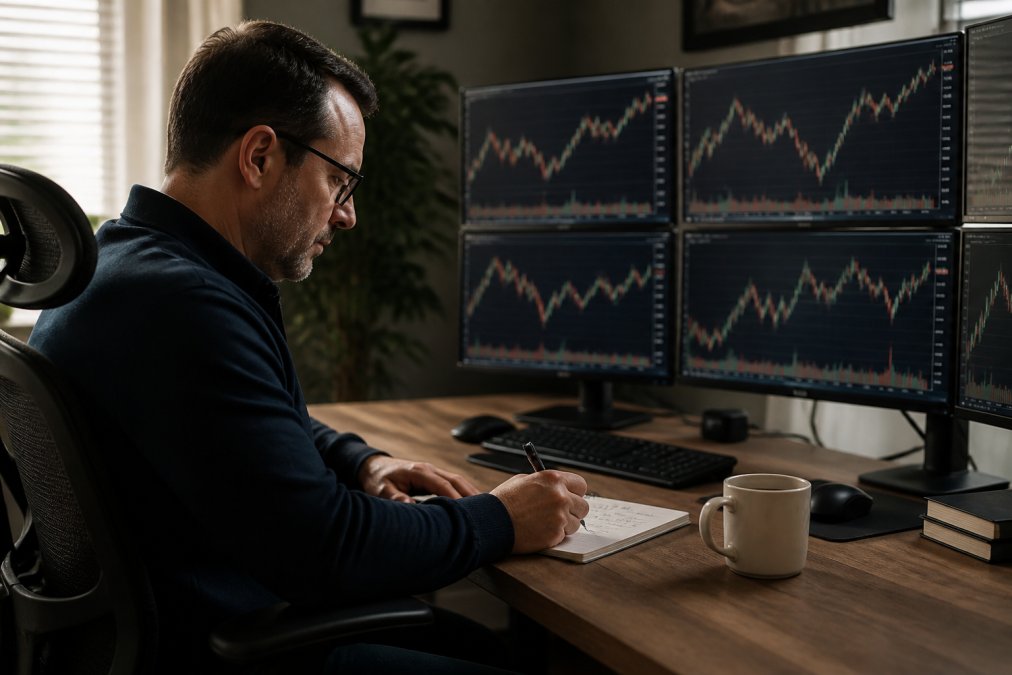
Your post-trade routine happens after every trade closes:
- Record the trade in your journal with all relevant details
- Note your emotional state: How did you feel during the trade? Did you want to move your stop?
- Identify one thing you did well and one thing you could improve
- Take a 10-minute break before considering the next trade
The post-trade routine prevents emotional momentum from one trade bleeding into the next. After a loss, you’re tempted to immediately "get it back" with a reckless trade. The 10-minute break and structured reflection interrupt this pattern.
Many successful traders use a simple rule: “After any losing trade, I step away for at least 30 minutes.” This simple pause prevents the cascade of bad decisions that often follows a loss.
Automating Your Way to Emotional Discipline
Automation is the nuclear option for emotional discipline. If you can automate your trade execution, you eliminate the possibility of emotional deviation. Systems like those offered by EZMT5 allow you to define your trading rules once and then execute them automatically without manual intervention on every trade.
When your trading system is automated, you don’t have to make real-time decisions about whether to enter or exit. The system makes those decisions based on the rules you’ve defined. This removes fear, greed, and FOMO from the equation entirely. You wake up, check your journal, and see what your system did overnight.

Automation also creates accountability. Your system trades exactly as programmed. If your system is losing money, you can see clearly whether the problem is the system design or your execution. If you were trading manually, you’d have the excuse that you "didn’t follow the plan perfectly."
The key to successful automation is brutal honesty about your system’s performance. Many traders backtest on historical data and see great results, then get disappointed when live trading produces different results. This is normal. Live markets include slippage, spreads, and the impact of your own trades. At EZMT5, the systems are pre-built and optimized specifically to work in live market conditions.
A common mistake is automating a system without understanding how it works. If you don’t know why your system enters [and exits](/improving-entries-and-exits-mt5-improving-entries-exits-mt5-guide/) trades, you won’t have the confidence to stick with it during drawdowns. Spend time understanding your system before you automate it.
Managing fear and greed in trading isn’t about becoming emotionless. It’s about building systems and routines that prevent emotions from overriding your judgment when real money is on the line. A trading plan removes the need for in-the-moment decisions. Risk management limits the emotional pain of losses. A trading journal creates accountability. A pre- and post-trade routine builds consistency. And automation executes your rules without deviation.
EZMT5 provides the tools to automate this process with fully built, optimized MT5 trading systems that execute with precision. You get real-time trade opportunities, professional-grade indicators, and the flexibility to use two license keys per system across multiple accounts. Start trading immediately after download and begin building the discipline that separates profitable traders from the rest.
Frequently Asked Questions
How does emotional discipline impact long-term trading success?
Emotional discipline separates profitable traders from those who lose money. When you remove fear-driven panic selling and greed-driven overtrading from your decisions, you follow your trading plan consistently. This consistency compounds over time. Traders with strong emotional discipline stick to their position sizing, respect their stop-loss orders, and exit trades according to their pre-planned strategy rather than chasing profits or revenge trading after losses. Over months and years, this discipline creates the compounding effect that builds real wealth.
Can automated trading systems help remove fear and greed from my trading?
Yes. Automated trading systems execute trades based on predefined rules, not emotions. Once your system enters and exits a trade, the decision is made, no second-guessing, no watching the price tick up and down, no impulse to add to a winning position or close early. Automated systems enforce your trading plan exactly as written. However, automation only works if your underlying plan is sound. You still need to manage risk, review your system's performance in a trading journal, and adjust your strategy based on market conditions rather than emotion.
What should I include in a trading journal to track emotional patterns?
Your trading journal should record: the date, entry price, exit price, reason for the trade, and outcome. More importantly, add a column for your emotional state during the trade, were you confident, anxious, greedy, or fearful? Note whether you followed your trading plan or deviated due to emotion. Track your drawdowns and how you responded to them. Over time, patterns emerge: you might notice you overtrade after losses, or hold winners too long hoping for bigger profits. These patterns are the gaps where fear and greed leak into your trading. Reviewing them weekly helps you strengthen your discipline.
Why do most retail traders fail to manage emotions?
Most retail traders fail because they trade without a plan. Without predefined entry and exit rules, every price movement triggers an emotional decision. Small losses feel catastrophic, so fear forces an exit. Small wins feel like the start of a big move, so greed keeps them in. No two trades follow the same logic. Traders who succeed build a written trading plan first, then use a trading journal to track whether they follow it. They also use risk management tools like stop-loss orders and position sizing to limit the damage when emotions flare. The traders who fail skip these steps and trade on impulse.
This article was written using GrandRanker