

Table of Contents
- MambaFX vs Professional Trading Systems: What You’re Actually Comparing
- Retail vs Institutional Trading Strategies: Core Methodological Differences
- Automated MT5 Trading Systems: How They Execute vs Manual Retail Approaches
- Risk Management in Automated Trading: Capital Preservation and Drawdown Control
- Performance Metrics That Matter: Win Rate, Risk-Reward Ratio, and Backtesting Reality
- Legitimacy Checklist: Evaluating Professional Trading Systems for Real-World Viability
- Making Your Choice: Which Approach Fits Your Trading Goals
Last Updated: August 17, 2026
MambaFX vs Professional Trading Systems: What You’re Actually Comparing
When traders compare MambaFX to professional trading systems, they’re asking the wrong question. The real distinction isn’t between competing platforms, but between two fundamentally different approaches to executing trades: retail-focused services built for individual traders seeking simplicity, versus institutional-grade infrastructure designed for precision, scalability, and measurable performance.
At EZMT5, we’ve analyzed how traders evaluate their options, and the pattern is clear: most comparisons miss the structural differences that actually matter. This guide breaks down what separates retail trading methodologies from professional systems, how they execute differently, and which approach aligns with your actual trading goals.
Retail vs Institutional Trading Strategies: Core Methodological Differences

The gap between retail and institutional trading isn’t about equipment, it’s about how capital and risk are managed at fundamentally different scales. Retail traders operate on smaller account sizes with discretionary decision-making, while institutional systems execute with predefined rules, strict risk parameters, and automated execution.
MambaFX operates in the retail space, emphasizing manual trade selection, community-driven signals, and broker partnerships for individual traders. The appeal is straightforward: access to other traders’ ideas and manual execution. This works when market conditions align with signal quality, but introduces critical dependency on the judgment of signal generators.
Professional trading systems use quantitative models, backtested strategies, and automated execution rules that remove emotion. They don’t ask "what should I trade today?" but "what does market structure tell us about optimal entry and exit points?" The methodology is repeatable, testable, and measurable.
The methodological difference shows immediately in trade management. Retail approaches rely on discretionary exits based on feel or intuition. Professional systems use predetermined risk-reward ratios, technical levels, and time-based exits. Drawdown handling differs critically: in retail signal-based models, drawdown occurs when the signal-generator’s edge deteriorates with no built-in circuit breaker. Professional systems include explicit drawdown controls, maximum acceptable loss per trade, daily loss limits, and position sizing rules that scale down after losses.
Automated MT5 Trading Systems: How They Execute vs Manual Retail Approaches
When comparing MambaFX’s manual execution to automated MT5 systems, you’re comparing two entirely different operational frameworks.
MambaFX requires active participation: receive signal, evaluate, decide to execute, manage position manually. This creates three problems: latency, discretion, and scalability. Between signal arrival and execution, market conditions change. Between decision and entry, slippage accumulates. Between managing one position and five, attention divides.
Automated MT5 systems eliminate these friction points. An Expert Advisor receives the signal, evaluates it against current market conditions, executes at the optimal moment, and manages the position according to predefined rules. No hesitation. No missed opportunities. No manual oversight required once deployed.
The execution difference becomes critical in volatile markets. When price action moves fast, especially in forex during major economic releases or crypto during trending moves, the lag between signal and execution costs money. A professional automated system executes in milliseconds. A manual trader might miss the optimal entry entirely.
EZMT5’s approach demonstrates this advantage: fully built and optimized MT5 trading systems execute automatically across 11 different strategies simultaneously. Each system monitors assigned markets, identifies entry signals according to specific technical criteria, and executes trades without human confirmation. Position management is equally precise: predefined stop losses close immediately, profit targets lock in gains, and maximum drawdown thresholds halt new trades until recovery.
Scalability differs fundamentally. A manual trader managing three accounts faces coordination problems. Automated systems handle this elegantly: each account runs independently while the trader monitors aggregate performance from a single dashboard.
Risk Management in Automated Trading: Capital Preservation and Drawdown Control
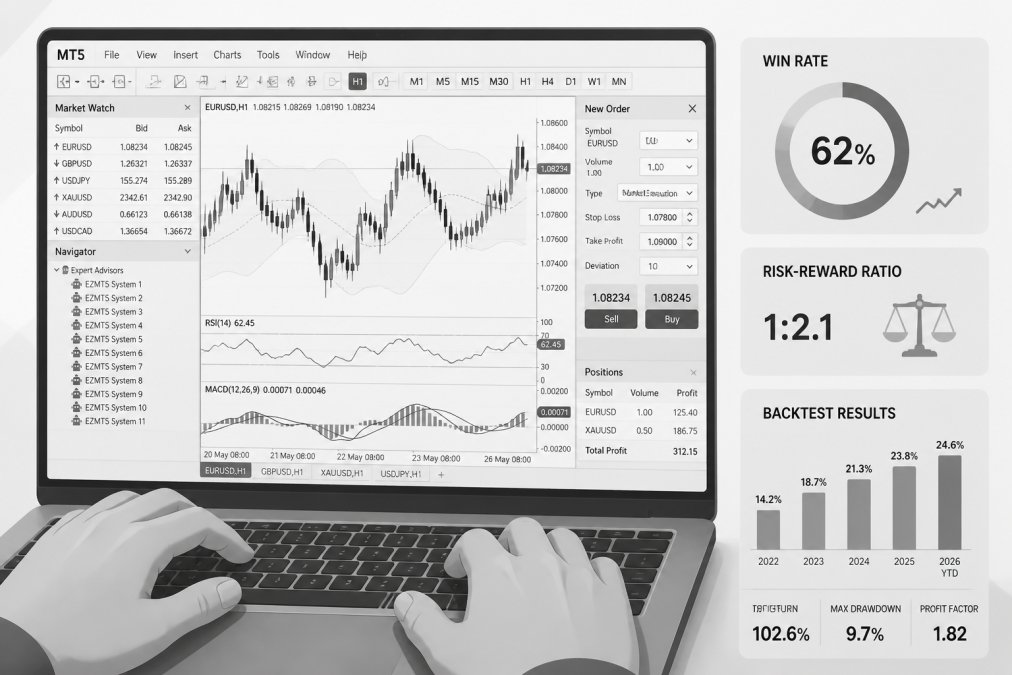
Risk management separates traders who survive from those who blow accounts. Professional systems demonstrate structural advantage over retail approaches.
Retail trading with MambaFX-style signals relies on individual traders to implement risk controls. You receive a signal and decide position size, stop loss, and exit target. This places enormous burden on discipline. When trades move against you, temptation to move stops or hold longer becomes overwhelming. Most retail traders fail not because signals are bad, but because they don’t stick to risk rules.
Professional automated systems enforce risk management mechanically. Position sizing calculates automatically based on account equity and trade risk parameters. Stop losses are set before entry and cannot be moved. Profit targets are predetermined. The system won’t deviate regardless of price action or confidence.
Drawdown control is most visible here. A retail trader might experience 40% drawdown before acting. A professional system stops accepting new trades at 20% drawdown, preventing further damage while the account recovers. A 20% loss requires 25% gain to recover. A 40% loss requires 67% gain. Professional systems enforce this math.
Leverage use also separates approaches. Retail traders often use high leverage (10:1, 20:1, 50:1) to amplify returns. But leverage amplifies losses equally. A 5% adverse move with 10:1 leverage wipes out 50% of your account. Professional systems use conservative leverage (2:1 to 5:1) because the goal is sustainable returns, not maximum returns on single trades.
Risk-reward ratio enforcement is another mechanical advantage. Professional systems won’t enter trades unless potential reward is at least 1.5x the risk. Over 100 trades, this single rule increases expected return significantly. Volatility adjustment is also built in: position sizes scale down during volatility spikes and up when volatility drops, keeping risk exposure constant regardless of market conditions.
Performance Metrics That Matter: Win Rate, Risk-Reward Ratio, and Backtesting Reality
Win rate is perhaps the most misunderstood metric in retail trading. A 35% win rate can be vastly more profitable than 65% win rate. Everything depends on risk-reward ratio and execution consistency.
MambaFX often highlights win rate because it’s easiest to advertise. "Our signals win 60% of the time" sounds compelling but obscures the critical question: what’s average win size versus average loss size? If you win 60% but lose 3x as much on losses, you operate at net loss over time.
Professional trading systems publish complete metrics: total return, maximum drawdown, win rate, average win size, average loss size, profit factor, and Sharpe ratio. These together paint a complete picture. A system with 40% win rate, 2:1 average risk-reward ratio, and 0.8 profit factor is genuinely profitable. A system with 65% win rate, 0.8:1 risk-reward ratio, and 0.6 profit factor is money-losing.
Backtesting reveals whether a system works in historical conditions. A system that backtests beautifully can fail live if market conditions, volatility, or liquidity have changed, or if the backtest was overfitted to historical data.
Professional systems use walk-forward testing: backtest on one data period, then test on completely separate period it’s never seen. If performance is similar, you have evidence the system generalizes. If it only works on training data, it’s overfitted and will fail live.
EZMT5’s 11 trading systems have been built through rigorous testing. Each has documented performance across different market conditions. The advantage isn’t that every system wins every month, but that the collection performs consistently because they’re designed for different environments. One excels in trending markets, another in range-bound conditions, another during high volatility. Together, they smooth returns across varying conditions.
The critical insight: a single system claiming 80% accuracy in any market is almost certainly lying. Professional systems are honest about limitations. "This system works in trending markets with volatility above 15 pips per hour." That specificity makes it trustworthy.
Legitimacy Checklist: Evaluating Professional Trading Systems for Real-World Viability
How do you distinguish legitimate professional trading systems from marketing hype?
Documented performance history. Legitimate systems publish audited, third-party verified results from tracking services like MyFXBook. If a system won’t provide verified results, don’t trade it.
Realistic return expectations. Any system claiming 50%+ monthly returns is a scam. Institutional hedge funds target 15-25% annual returns. Professional trading systems typically aim for 20-40% annual returns with manageable drawdown.
Transparent methodology. You should understand the system’s core logic. "It uses price action and support/resistance levels" is legitimate. "It’s a secret algorithm" is a red flag.
Backtesting transparency. How far back was the system tested? Over what market conditions? What was maximum drawdown? Legitimate systems provide this detail.
Regulatory compliance. Anyone offering trading advice or managing accounts must be registered with the SEC or FINRA. Verify their regulatory status. The SEC provides searchable databases for investment advisers, and FINRA provides information about registered firms and individuals.
No-guarantee disclaimer. Legitimate systems acknowledge that past performance doesn’t guarantee future results. Guarantees violate regulations.
Community feedback and longevity. Systems operating 3+ years with active user communities tend to be legitimate. New systems with perfect marketing and no real users are often pre-launch scams.
Source code or EA transparency. For MT5 systems, you should verify the Expert Advisor’s behavior and audit its logic. Systems hiding execution are suspicious.
Refund and support policy. Legitimate vendors offer reasonable refund periods (30 days minimum) and responsive support.
EZMT5 passes all these checks. The systems are fully built and optimized, available immediately for testing, documented with clear performance expectations, and backed by a no-contract subscription model. Two license keys per system let you deploy across multiple accounts without licensing complications.
Making Your Choice: Which Approach Fits Your Trading Goals
The decision between MambaFX-style retail trading and professional automated systems depends on your trading goals, time availability, and risk tolerance.
Choose retail signal-based trading if you enjoy active participation, have time to monitor signals and execute manually, and view trading as part of your daily routine. The advantage is engagement and learning. The disadvantage is inconsistency based on discipline and emotional state.
Choose professional automated trading systems if you want consistent, measurable results without daily involvement, need to scale across multiple accounts, and prioritize capital preservation. The advantage is consistency and scalability. The disadvantage is less engagement and learning.
Many traders use a hybrid approach: professional automated systems for core trading plus occasional manual trades based on personal analysis. This provides consistency plus engagement.
For traders seeking professional-grade systems without building their own, EZMT5 provides fully built and optimized MT5 trading systems. The 11 systems cover different market conditions, reducing risk that all systems fail simultaneously. Real-time trade opportunities arrive automatically with precision execution. Two license keys per system let you deploy across multiple accounts, and no-contract subscription lets you adjust as your trading evolves.
The real comparison is whether you want to spend energy learning to trade manually or whether you want proven systems handling execution while you focus on strategy and capital management. Both paths work. The question is which aligns with how you want to spend your time and manage your capital.
The trading landscape has shifted toward automation and data-driven decision-making. If you’ve been managing trades manually and struggling with consistency, professional trading systems eliminate the execution variables that hold most traders back. EZMT5’s fully built MT5 trading systems start delivering real-time trade opportunities immediately after download, with precision execution and proven risk management already configured. Start trading like a professional today without the years of learning curve.
Frequently Asked Questions
How do professional trading systems differ from influencer-led retail strategies like MambaFX?
Professional trading systems rely on institutional frameworks: quantified risk management, standardized entry and exit rules, and backtested performance across market cycles. Retail strategies, often promoted through social media, depend on personality and narrative appeal rather than documented methodology. Professional systems prioritize capital preservation and measurable win rates; retail approaches often emphasize short-term wins and social proof. The difference lies in accountability, professional systems publish performance metrics and risk parameters; retail strategies typically avoid specific drawdown or loss disclosures.
What should I look for when evaluating an automated MT5 trading system's legitimacy?
Check three core elements: documented backtesting across multiple market conditions (not just bull markets), transparent risk management rules (stated maximum drawdown and position sizing), and verifiable live trading results from independent sources. Legitimate automated MT5 trading systems disclose their win rate, average risk-reward ratio, and monthly performance variance. Ask whether the system has been tested during volatile market periods and how it performs when volatility spikes. Avoid systems that promise consistent returns or show only cherry-picked results.
Is an automated trading system more reliable than manual trading strategies?
Automated systems execute trades without emotion and enforce risk management rules consistently. Manual strategies allow for market adaptation but depend on trader discipline and emotional control. Reliability depends on the system's design quality, not automation alone. A poorly coded automated system can fail under slippage or liquidity constraints. A disciplined manual trader using professional methodology can outperform a flawed automated system. The advantage of automation is consistency in execution, not inherently superior returns.
What are the main risks of following social media-based trading strategies?
Social media trading strategies carry several risks: survivorship bias (only profitable trades are highlighted), lack of risk disclosure, unverified performance claims, and no accountability for losses. These strategies often lack documented risk management, making drawdowns unpredictable. Many influencer-led approaches depend on high leverage and scalping, which amplify losses during volatile periods. Additionally, the performance you see may reflect past conditions that won't repeat. Professional trading systems publish methodology and risk parameters; social media strategies typically do not.
This article was written using GrandRanker