

Last Updated: November 4, 2026
Quick Summary
Protect personal data from forex broker fraud by running a free CFTC and NFA registration check before wiring money, confirming the legal entity name matches the website, customer agreement, and wire instructions. Then secure your account with a unique password and multi-factor authentication, and never click login links in emails.
- Search the firm’s name in the NFA registration database and save a dated screenshot of the record.
- Match the registration number to the exact legal entity name on the contract and wire instructions.
- Turn on app-based multi-factor authentication instead of SMS where offered.
- File with the FTC at ReportFraud.ftc.gov and your state attorney general after a breach.
- A recovery agent demanding an upfront fee after your loss is almost always a second scam.
Table of Contents
- Why Forex Broker Fraud Targets Your Personal Data
- How to Run a CFTC Forex Broker Registration Check
- Red Flags in Broker Emails, Portals, and Onboarding Forms
- Securing Online Brokerage Accounts With Strong Authentication
- Hardening Your Browser and Devices Before You Log In
- How to Report Forex Trading Scams and Recover After a Breach
- Limiting Exposure to Data Brokers and Third-Party Trackers
- Running Your Automated Systems on a Verified Broker Account
- Frequently Asked Questions
Why Forex Broker Fraud Targets Your Personal Data
Forex broker fraud starts with your inbox, not your trading account.
Traders often focus on spreads and systems. Fraudsters focus on the paperwork.
Here is what makes this market so exposed:
- High account values. Trading accounts hold real money and move it fast.
- Heavy documentation. Passport scans, proof of address, bank statements.
- Speed pressure. Fake “deposit now” deadlines stop people thinking.
Identity theft is the real prize. A stolen profile can open accounts, pass verification, and move money before you notice.
Watch out: reusing your trading password on email or social accounts is a common mistake.
If you want to go deeper on spotting fake signal sellers, read our guide to protecting your capital from fraudulent trading signals.
How to Run a CFTC Forex Broker Registration Check
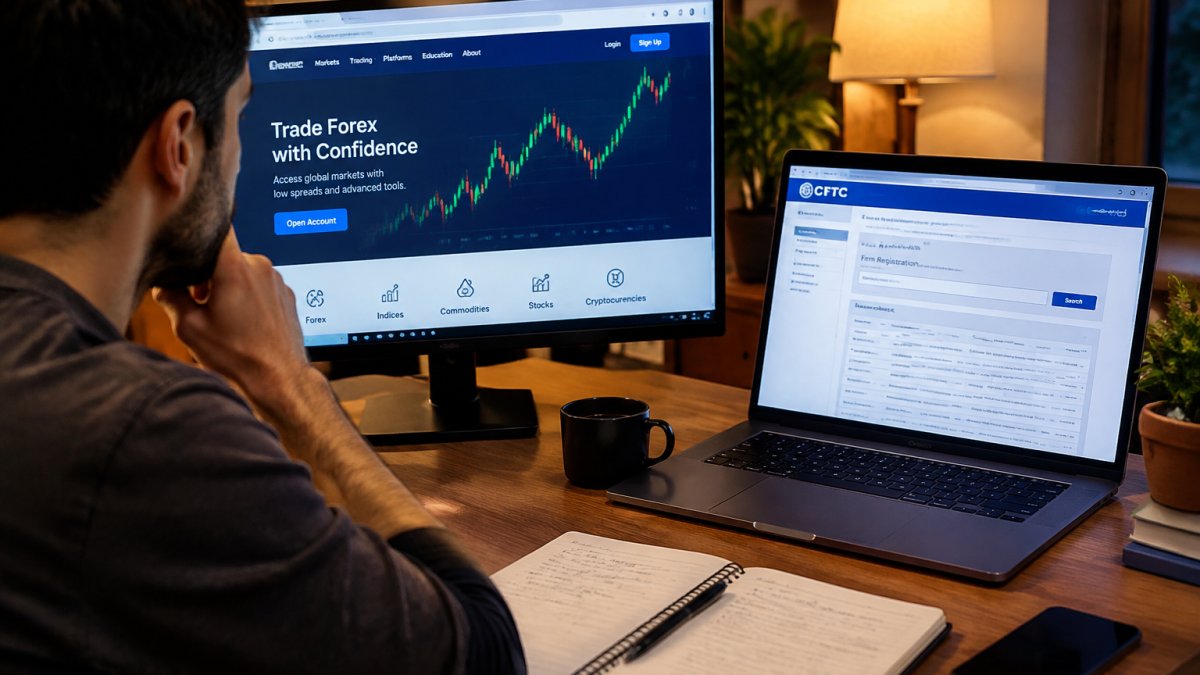
A CFTC forex broker registration check can be done quickly and at no cost. It confirms whether the firm is registered with the Commodity Futures Trading Commission and listed with the National Futures Association, and it is a useful verification step before wiring money.
Do it in this order:
- Go to the NFA registration database and search the firm’s name.
- Confirm the legal entity name matches the website, the customer agreement, and the wire instructions.
- Check the firm’s registration status and any disciplinary history.
- Compare the contact details against the site.
- Save a screenshot of the record with the date.
Reading the NFA and CFTC Records Behind a License
Registration is not a quality badge, it only confirms a firm met filing requirements.
Look for three things:
- Status. Active, pending, or withdrawn.
- Disclosures. Customer complaints, arbitrations, or regulatory actions.
- Scope. Whether retail forex is covered by the registration.
An unauthorised firm often copies a real license number from a legitimate broker. Always match the number to the exact entity name.
Cross-Referencing the Registration Number Against the Legal Entity
The registration number only matters if it maps to the entity holding your money. A common pattern is a website showing a legitimate NFA ID while the customer agreement names an offshore shell with a similar name. Cross-check three things before depositing:
- Entity name on the contract. The legal name on the customer agreement must match the NFA record exactly, including suffixes like LLC, Ltd., or Inc.
- Entity name on the wire instructions. If the bank beneficiary differs from the registered entity, stop and ask why in writing.
- Entity name on the website footer and disclosures. Cloned sites frequently leave the real firm’s name in one place and the clone’s name in another.
A second pattern is the cloned license: a fraudster lifts a real broker’s NFA ID and builds a lookalike site around it. The tell is usually a mismatch between the registered firm’s listed address or phone number and the site’s contact details. Call the number in the NFA record, not the one on the website.
What CFTC Registration Categories Mean for Retail Forex
Not every CFTC registration covers retail forex. The categories that matter most to individual traders are:
- Retail Foreign Exchange Dealer (RFED). A firm that acts as the counterparty to retail forex trades. This is the category most retail forex brokers fall under.
- Futures Commission Merchant (FCM). A firm that solicits or accepts orders for futures and options and, in some cases, retail forex. An FCM that offers retail forex must be registered and must meet minimum adjusted net capital requirements.
- Introducing Broker (IB). A firm that solicits customers but does not hold funds. An IB must be registered and must be guaranteed by an FCM or RFED.
If a firm claims to be a broker but is registered as an IB, it should not be holding your deposit. If it claims an FCM registration but the NFA record shows retail forex is conducted by a different entity, treat that as a red flag until explained in writing.
Checking Disclosures and Regulatory Actions
The NFA record includes a disclosures section. Read it rather than skimming the status line.
Also check the CFTC’s public enforcement actions and the NFA’s disciplinary actions for the firm and its principals.
Watch out: a firm that pressures you to deposit before you have finished the registration check is telling you what the check will find.
Once you know how to check, the next step is building a shortlist you can compare. Our list of the top 10 forex brokers in the world gives you vetted names to check against.
Run the registration check in this order before wiring any money.
| Step | What to do |
|---|---|
| 1 | Search the firm’s name in the NFA registration database |
| 2 | Confirm legal entity name matches website, agreement, wire instructions |
| 3 | Check registration status and any disciplinary history |
| 4 | Compare the contact details against the site |
| 5 | Save a screenshot of the record with the date |
Red Flags in Broker Emails, Portals, and Onboarding Forms
Fraud often arrives through channels you already trust: email, a login portal, or an onboarding form.
Look for these red flags:
- Urgency. “Verify within 24 hours or your account is frozen.”
- Wrong domain. A lookalike address one letter off the real one.
- Payment requests. Deposits to personal accounts or crypto wallets.
Phishing pages are a common tool. They can closely copy a real portal, then harvest your login.
Watch out: never click a login link in an email. Type the address yourself.
Our red flags in forex trading software guide covers the warning signs inside the tools themselves.
Securing Online Brokerage Accounts With Strong Authentication
Securing online brokerage accounts comes down to two controls: a unique password and multi-factor authentication.
Multi-factor authentication, often called two-factor authentication, adds a second proof of identity beyond your password. Even a stolen password then fails.
Password Hygiene and Multi-Factor Authentication Setup
Set it up like this:
- Use a password manager to generate a unique password per account.
- Aim for long passphrases, not clever substitutions.
- Turn on app-based authentication instead of SMS where offered.
- Store backup codes offline, not in your inbox.
- Review active sessions monthly and kill anything unfamiliar.
This blocks credential stuffing: criminals replay leaked passwords from one breach across banking and brokerage logins.
If you use automated trading software, demand the same standards. Our guide to essential security features for automated forex software lists what to check.
Hardening Your Browser and Devices Before You Log In
Your browser is the front door to your brokerage account. Harden it before you type a password.
A practical setup:
- Keep the browser and operating system fully patched.
- Remove extensions you do not recognize.
- Use a reputable password manager extension only.
Social engineering often beats technical defences. A caller claiming to be from support will ask you to install remote-access software.
Privacy-focused browsers and tracker blockers reduce the data brokers collect about you, shrinking the raw material for a future attack.
Before buying any trading tool, read our security tips for buying MT5 software.
How to Report Forex Trading Scams and Recover After a Breach
Reporting quickly can limit the damage, and speed generally matters more than perfect wording.
Follow this recovery roadmap:
- Contain. Change passwords everywhere, starting with email.
- Lock. Ask the broker to freeze the account and flag suspicious activity.
- Report. File with the FTC at ReportFraud.ftc.gov and your state attorney general.
- Notify the NFA if a registered firm is involved.
- Document. Keep every email, screenshot, and transaction record.
- Monitor. Watch credit reports and account statements for months.
- Warn. Tell your bank, since identity theft often spreads to banking.
Consumer protection bodies cannot always recover funds. They can, however, flag the firm to help warn other traders.
Filing With the Right Agency the First Time
Each agency has a different remit, and filing with the wrong one costs days you do not have. Match the agency to the harm:
- FTC (ReportFraud.ftc.gov). The right first stop for the fraud itself, fake broker sites, phishing, imposter support calls. The FTC does not recover individual funds, but its reports feed law enforcement and its identity theft resources include a personal recovery plan you can generate and print.
- CFTC (cftc.gov/complaint). File here if a registered or purportedly registered firm is involved, or if the conduct involves retail forex, futures, or options. The CFTC’s complaint portal routes to its Division of Enforcement.
- NFA (nfa.futures.org). File a complaint against an NFA member firm. The NFA can arbitrate disputes with member firms and can take disciplinary action, but it cannot act against unregistered entities.
File with more than one agency when the facts fit more than one remit. Cross-referencing reports is how patterns get built.
What Each Agency Can and Cannot Do
Set expectations before filing so you do not mistake a report for a recovery. The FTC and IC3 collect intelligence and refer cases; they do not return money. The CFTC and NFA can discipline registered firms and sometimes order restitution through enforcement or arbitration, but have no jurisdiction over unregistered offshore operations. Your bank can reverse unauthorized transfers within its dispute window, but not a transfer you authorized to a fraudulent broker.
Freezing Your Credit and Locking Your Identity
If identity documents were exposed, passport scans, proof of address, bank statements, assume the data will be used. Credit freezes and fraud alerts are options offered by the major credit bureaus. Check each bureau’s official website for current terms and availability.
Also consider:
- IRS Identity Protection PIN. If your Social Security number was exposed, request an IP PIN from the IRS so a return cannot be filed in your name (Get an identity protection PIN).
- ChexSystems. A consumer reporting agency used by banks; a freeze or alert there limits new bank account fraud.
- Password manager audit. After a breach, rotate every credential stored in the manager and revoke active sessions on email, banking, and brokerage accounts.
The First 72 Hours, Then the First 30 Days
The timeline that matters:
- Within hours. Change email and brokerage passwords, revoke sessions, enable MFA, and call the broker to freeze the account.
- Within 24 hours. File the FTC report, contact your bank about any unauthorized transfer, and place a fraud alert or freeze.
- Within 72 hours. File with the CFTC or NFA if a registered firm is involved, and file an IC3 report if money moved.
Watch out: a “recovery agent” who contacts you after the loss asking for an upfront fee to retrieve your funds is almost always a second scam targeting the same victim.
Documenting the Case So It Survives Scrutiny
Build one folder with the customer agreement, every deposit and withdrawal record, all email and chat logs, screenshots of the site and NFA record, and a dated timeline. Regulators and banks move faster with a clean, chronological record, and if the case goes to NFA arbitration, that folder becomes your evidence file.
Limiting Exposure to Data Brokers and Third-Party Trackers
Data brokers trade in profiles built from your browsing, purchases, and public records. Each profile is another set of answers a fraudster can use to pass verification questions.
Reduce the surface area:
- Opt out of major data broker listings where state law allows.
- Block third-party trackers in your browser.
- Use separate email addresses for trading and general browsing.
Data privacy is not paranoia. It is basic fraud prevention.
Compliance teams at regulated firms will never ask for more than standard verification. Treat extra requests as suspicious activity.
Running Your Automated Systems on a Verified Broker Account
Automation amplifies whatever it is connected to, so it is worth confirming the broker and account security before you connect any system.
Before you connect any system, confirm:
- The broker is registered and the entity name matches.
- Multi-factor authentication is on.
- The account uses a unique password.
EZMT5 offers access to MT5 Trading Systems and TradingView indicators on a no-contract subscription. Visit the EZMT5 website for current details.
The systems handle execution. The security decisions stay yours, and they start with a broker you have checked.
Frequently Asked Questions
How can I verify if a forex broker is registered with the CFTC?
Look up the firm in the NFA’s BASIC database, which lists firms registered with the CFTC as retail foreign exchange dealers and their associated persons. Search the exact legal name, not the brand name on the website, and confirm the registration status is current. Cross-check the address and contact details against the firm’s own site. If the company does not appear, or appears under a different entity than the one holding your money, treat it as an unregistered firm and do not send funds.
What are the common signs of a fraudulent forex broker?
Watch for guaranteed returns, pressure to deposit quickly, bonuses tied to larger deposits, and withdrawal requests that stall behind new verification demands. Fake brokers often use cloned websites with slight spelling changes, contact you first through social media or messaging apps, and provide account statements that live only inside their own portal. A legitimate firm lets you withdraw without conditions and has a verifiable registration record. Any request to pay fees or taxes before a withdrawal is a classic forex broker fraud pattern.
What should I do if I suspect my personal data has been compromised by a broker?
Change the password on that brokerage account immediately, then change it anywhere you reused the same credentials. Turn on multi-factor authentication, review recent login history and withdrawal activity, and ask the broker in writing what data was exposed. Place a fraud alert or freeze with the major credit bureaus if you shared a Social Security number. File a complaint with the CFTC and the NFA, and report identity theft at IdentityTheft.gov. Keep copies of every message and statement for your records.
How do I report forex trading scams to the authorities?
File a complaint with the CFTC through its online complaint portal and with the NFA if the firm claims membership. Report the fraud to the FBI’s Internet Crime Complaint Center and to your state attorney general. Include the firm’s name, website, account numbers, payment methods, and copies of correspondence. Acting quickly matters because wire transfers and crypto deposits are hard to reverse. After reporting, stop all contact with the firm and do not pay any additional fees they demand to release your funds.
Fraud prevention is a habit, not a one-time task. Verify every broker, lock every login, and treat urgency as a warning. EZMT5 gives you the automated systems; pair them with a verified account, two changeable license keys, and no-contract access to keep your setup both fast and safe. Get started with EZMT5 and trade with tools built for precision.
