

Table of Contents
- Is MT5 Good for Cryptocurrency Trading? The Verdict First
- What You’re Actually Trading: Crypto CFDs vs. Spot Ownership
- MT5 Crypto Trading Fees: What It Really Costs You
- Key Features That Make MT5 a Serious Crypto Trading Platform
- How to Trade Crypto on MT5: Step-by-Step
- MT5 vs. Crypto Exchange: Which Is Right for Your Strategy?
- Is MT5 Good for Cryptocurrency Trading with Automated Systems?
- Pros and Cons of Using MT5 for Crypto Trading
Last Updated: June 18, 2026
Traders who have spent time on crypto exchanges often ask whether switching to a professional desktop platform actually changes their results. The answer to is MT5 good for cryptocurrency trading depends on one critical distinction most guides gloss over: you are not buying Bitcoin on MT5, you are trading contracts for difference (CFDs) on its price. This guide from EZMT5 breaks down exactly what that means, what it costs, and whether the platform’s institutional-grade toolset justifies the trade-off, covering fees, execution quality, automated trading, and the angles most broker-sponsored reviews skip.
Is MT5 Good for Cryptocurrency Trading? The Verdict First
MetaTrader 5 is a multi-asset institutional trading platform that gives traders access to cryptocurrency CFDs alongside forex, indices, and commodities through a regulated broker. For traders who prioritize technical analysis depth, automated strategy execution, and structured risk management, MT5 is genuinely strong. For traders who want to hold actual Bitcoin in a wallet, stake assets, or access hundreds of altcoins, it is the wrong tool entirely.
MT5 Crypto Trading: Scoring Summary Table
| Criteria | MT5 Score | Notes |
|---|---|---|
| Technical Analysis Tools | 9/10 | 38+ indicators, 21 timeframes, 44+ graphical objects |
| Automated Trading (EAs) | 9/10 | MQL5 ecosystem, multi-threaded backtesting |
| Asset Variety | 5/10 | Limited to broker-listed CFD pairs |
| True Ownership | 0/10 | CFDs only, no wallet, no staking |
| Execution Speed | 7/10 | STP execution, latency varies by broker |
| Beginner Friendliness | 5/10 | Steeper learning curve than native exchanges |
| Regulation | 8/10 | Broker-dependent, generally well-regulated |
| Mobile Experience | 7/10 | Functional but desktop-first design |
Quick Verdict: MT5 is the right choice for systematic, technically-driven crypto traders. It is the wrong choice for crypto-native investors who want asset custody and on-chain activity.
What You’re Actually Trading: Crypto CFDs vs. Spot Ownership
The single biggest source of confusion around MT5 crypto trading is the CFD structure. A cryptocurrency CFD is a derivative contract where you speculate on price movement without ever holding the underlying asset. When you open a BTC/USD position on MT5, no Bitcoin changes hands, you are entering an agreement with your broker to settle the difference between your entry and exit price.
You cannot transfer your "Bitcoin" to a hardware wallet, use it in DeFi protocols, or hold it as a long-term investment. What you can do is go long or short with leverage, manage margin precisely, and apply institutional-grade risk tools to every trade. Spot trading gives you actual asset ownership and access to Web3 applications, but fewer analytical tools and no native automated trading infrastructure comparable to MT5’s Expert Advisor ecosystem.
CFD is a contract that tracks the price of an underlying asset, settled in cash, without requiring ownership or custody of that asset.
Trading crypto CFDs with leverage amplifies both gains and losses. A position moving against you by a small percentage can wipe out your margin deposit entirely. Always define your risk per trade before entering a position, not after.
Tax Implications of CFD vs. Spot Crypto Trading
This is the angle almost every broker-affiliated guide ignores. CFD gains and losses are typically treated as capital gains or income depending on your jurisdiction, but they are categorically different from spot crypto transactions in most tax frameworks. Spot crypto trades often trigger specific reporting requirements tied to asset disposal, cost-basis tracking, and wash-sale rules.
CFD profits are generally treated as trading income or short-term capital gains, and CFD losses may be treated differently from spot losses for tax-loss harvesting purposes. As documented in HMRC guidance on CFD taxation, CFD trading in the UK is treated as spread betting in certain structures, carrying its own tax treatment distinct from crypto asset disposal. Consult a tax professional familiar with both instruments before assuming your MT5 activity is reported the same way as exchange trading.
MT5 Crypto Trading Fees: What It Really Costs You
MT5 itself is free. The real cost structure sits at the broker level and comes in three forms: spread, commission, and overnight swap.
Spread is the difference between the bid and ask price. For BTC/USD, spreads on MT5 brokers commonly range from a few dollars to over thirty dollars per Bitcoin equivalent depending on volatility and the broker’s liquidity providers.
Commission applies on ECN or STP account types where the spread is tighter but a per-lot fee is charged on each side of the trade.
Overnight swap is where CFD costs diverge sharply from exchange fees. Holding a leveraged crypto CFD position overnight incurs a financing charge that can erode returns significantly on multi-day holds, a cost that does not exist when holding spot assets on an exchange. For long-term directional bets, spot ownership is almost always cheaper. For short-term, technically-driven trades opened and closed within the same session, the MT5 fee structure is competitive.
Always check your broker’s swap rates for crypto pairs before entering a multi-day position on MT5. Some brokers charge triple swap on Wednesdays to account for the weekend rollover. This is not disclosed prominently and catches many traders off guard.
Key Features That Make MT5 a Serious Crypto Trading Platform
The case for MT5 rests on its analytical and automation infrastructure, a real capability gap between MT5 and most native crypto exchange interfaces.
Advanced Charting, Indicators, and Timeframes
MT5 ships with 38 built-in technical indicators, 44 graphical objects, and 21 timeframes ranging from one minute to one month. For crypto traders who rely on technical analysis, this depth is significant given the 24/7 trading cycle that generates clean chart patterns.
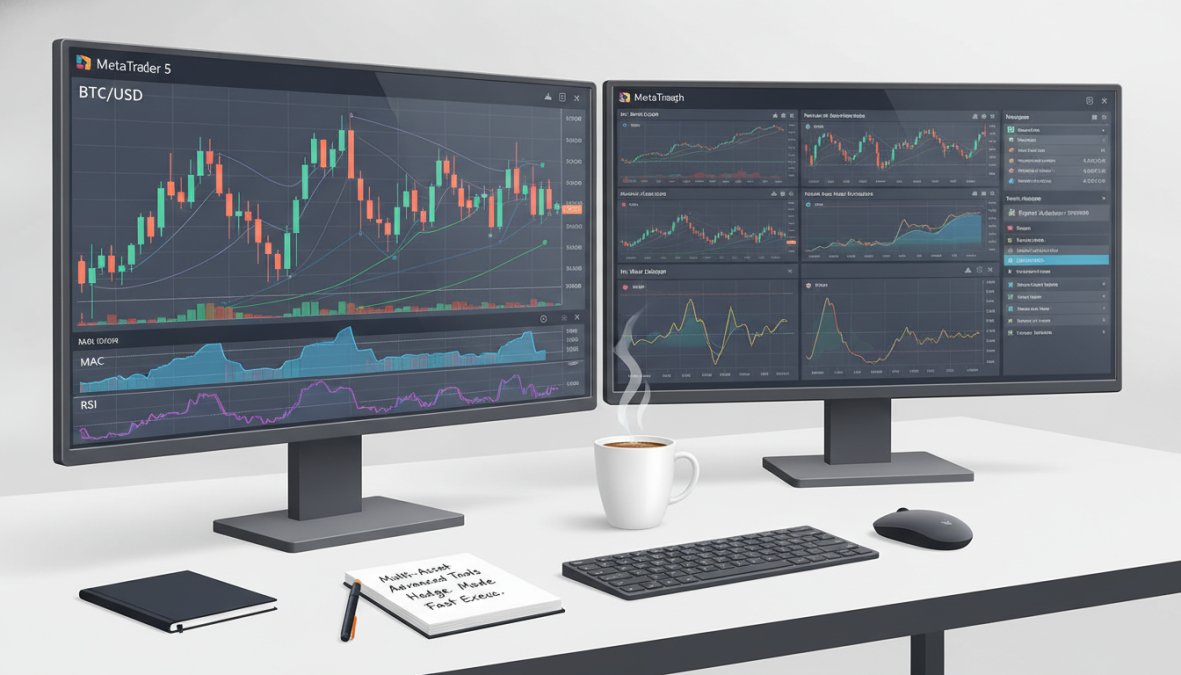
The platform supports custom indicators built in MQL5, giving access to thousands of additional tools via MetaTrader’s official marketplace. Six types of pending orders give crypto traders precise entry control in volatile markets where price can gap through a level quickly.
Automated Trading with Expert Advisors and Backtesting
This is where MT5 genuinely separates itself from every major crypto exchange. Expert Advisors are algorithmic trading programs written in MQL5 that execute trades automatically based on defined logic, automating entry signals, exit rules, position sizing, and risk management without manual intervention.
The multi-threaded strategy tester allows backtesting across historical crypto price data with real tick simulation, letting you test how a BTC/USD strategy would have performed over years of data before committing capital. Most crypto exchanges offer no comparable native backtesting infrastructure. For traders building systematic approaches, this capability alone justifies the learning curve.
Mobile vs. Desktop Experience on MT5
MT5’s mobile application covers the essentials, chart viewing, order placement, position monitoring, and basic indicator overlays. The honest assessment: MT5 is a desktop-first platform. The full indicator suite, EA management, strategy tester, and multi-chart layouts are desktop-only features. If your workflow depends heavily on mobile execution, cTrader’s mobile experience is more polished. If you are running automated systems and checking in periodically, MT5 mobile is sufficient.
How to Trade Crypto on MT5: Step-by-Step
- Choose a regulated broker that offers MT5 and lists crypto CFD pairs (BTC/USD, ETH/USD are standard minimums).
- Download MetaTrader 5 from the official MetaTrader website or your broker’s portal.
- Open a demo account first. MT5 demo accounts use live price feeds with virtual funds.
- Open the Market Watch panel (View > Market Watch or Ctrl+M) and search for BTC/USD or ETH/USD.
- Open a chart by right-clicking the pair in Market Watch and selecting "Chart Window."
- Apply your indicators from the Insert menu or by dragging from the Navigator panel.
- Place a trade by pressing F9 or clicking "New Order." Set your volume, stop loss, and take profit before confirming.
- Monitor your position in the Trade tab of the Terminal window at the bottom of the screen.
- Close the position by right-clicking it in the Trade tab and selecting "Close Order."
For automated trading, install your EA via the Navigator panel, attach it to a chart, and enable "Algo Trading" in the toolbar.
MT5 vs. Crypto Exchange: Which Is Right for Your Strategy?
| Feature | MT5 (via Broker) | Binance (Exchange) | cTrader (via Broker) |
|---|---|---|---|
| Asset Ownership | No (CFDs) | Yes (Spot) | No (CFDs) |
| Leverage | Yes (broker-dependent) | Yes (futures) | Yes (broker-dependent) |
| Automated Trading | Expert Advisors (MQL5) | API-based bots | cTrader Automate (C#) |
| Indicator Depth | 38+ built-in, thousands custom | Limited native tools | Good, smaller ecosystem |
| Overnight Fees | Yes (swap) | No (spot holds) | Yes (swap) |
| Asset Variety | Limited to broker list | Hundreds of pairs | Limited to broker list |
| Regulation | Broker-regulated | Exchange-regulated | Broker-regulated |
| Best For | Technical/systematic traders | Crypto-native investors | Active day traders |

If your strategy involves holding crypto for months, accumulating positions, or participating in on-chain activity, an exchange is the correct venue. If your strategy involves short-term technical trades, long/short positions, leverage, and systematic automation, MT5 through a regulated broker is the stronger environment.
Platform Latency, Slippage, and Execution Quality
Execution quality on MT5 is broker-dependent. MT5 supports STP execution, routing orders directly to liquidity providers without a dealing desk, which reduces requotes, but latency still varies based on your broker’s server location and liquidity relationships. In crypto markets, where price can move several hundred dollars in seconds, slippage is a real operational concern. Traders running EAs should test execution quality on their specific broker’s demo account during volatile periods before deploying capital. According to research on algorithmic trading execution quality, execution latency and slippage are among the primary factors separating profitable systematic strategies from marginal ones in volatile asset classes.
Is MT5 Good for Cryptocurrency Trading with Automated Systems?
For automated crypto trading specifically, MT5 is one of the strongest environments available outside of custom institutional infrastructure. The MQL5 language gives developers full control over order logic, risk parameters, and market condition filters, and the multi-threaded backtester runs historical simulations faster than most competing platforms.
The challenge is the barrier to entry. Writing a functional, safe EA requires programming knowledge and a deep understanding of how MT5 handles order states, error codes, and connection interruptions. A poorly written EA can place duplicate orders, fail to close positions during disconnections, or ignore stop-loss logic under certain conditions. This is where pre-built, professionally optimized systems change the equation entirely.
Prop Firm Integration and MT5 Crypto EAs
MT5’s dominance in the prop firm space is a fact that rarely gets mentioned in crypto trading guides. Many prop trading firms that fund external traders require accounts to run on MT5 and evaluate performance on MT5-based metrics. Trading crypto CFDs on MT5 keeps you within the required infrastructure rather than forcing you to maintain separate exchange accounts.
EZMT5 provides instant access to 11 fully built and optimized MT5 Trading Systems, including TradingView indicators, designed for traders who want to automate their crypto and multi-asset trading without building EAs from scratch. Each system comes with two reassignable license keys and a no-contract monthly subscription, removing the single largest barrier to entry for professional-grade automated strategies.
The prop firm ecosystem runs almost entirely on MT5. If you plan to pursue funded trading accounts, learning to trade crypto on MT5 is not optional, it is the prerequisite.
Pros and Cons of Using MT5 for Crypto Trading
Pros:
- Deep technical analysis environment with 38+ indicators and 21 timeframes
- Expert Advisor automation with institutional-grade backtesting
- Long/short positions with leverage give flexibility in both bull and bear markets
- Regulated broker infrastructure adds oversight absent on many exchanges
- Multi-asset platform lets you trade crypto, forex, and indices from one account
- Strong prop firm compatibility for traders pursuing funded accounts
Cons:
- No actual cryptocurrency ownership; CFD structure means no wallet, no staking, no on-chain activity
- Overnight swap fees make long-term holds expensive compared to spot exchange holdings
- Asset variety is limited to what your broker lists, typically far fewer pairs than major exchanges
- Steeper learning curve than modern crypto exchange interfaces
- Execution quality varies significantly by broker, not by the platform itself
- Mobile experience is functional but not optimized for mobile-first traders
The honest summary: MT5 is a serious tool for serious traders. Its weaknesses are structural (CFD-only, broker-dependent), not technical. As outlined in CFA Institute’s overview of derivative instruments, CFD structures carry specific risk characteristics that traders must understand before treating them as equivalent to spot market exposure. If those structural constraints align with your strategy, the platform’s analytical and automation depth is genuinely difficult to match.
The biggest obstacle most MT5 crypto traders face is not the platform itself; it is the time and expertise required to build, test, and optimize trading systems that actually perform. EZMT5 solves this directly by providing instant, unlimited access to 11 professional, fully built MT5 Trading Systems and TradingView indicators, with all future systems included and no contracts required. You can start trading immediately after download, with two reassignable license keys per system giving you the flexibility to adapt as your setup evolves. Get started with EZMT5 and begin executing automated crypto strategies on MT5 from day one.
Frequently Asked Questions
Can you trade actual cryptocurrency on MT5?
On MT5, you are typically trading cryptocurrency CFDs (Contracts for Difference), not actual coins. This means you speculate on Bitcoin (BTC/USD) or Ethereum (ETH/USD) price movement without owning the underlying asset or requiring a digital wallet. You gain access to leverage and short positions, but you do not receive coins you can transfer to a blockchain wallet. Whether MT5 is good for cryptocurrency trading in this context depends on whether CFD-style exposure fits your strategy.
What are the fees for trading crypto on MT5?
MT5 crypto trading fees are broker-dependent, not charged by the platform itself. Costs typically include the spread on each trade, overnight swap or rollover fees for positions held past market close, and sometimes a per-lot commission. These fees vary significantly between regulated forex brokers offering crypto CFDs. Always compare the spread on BTC/USD and ETH/USD across brokers, and factor in swap rates if you plan to hold positions longer than a single session.
What is the difference between MT4 and MT5 for crypto trading?
MT5 is the superior choice for crypto trading compared to MT4. MT5 offers 21 timeframes versus MT4's 9, a multi-threaded strategy tester for backtesting Expert Advisors across crypto pairs, more order types, and a built-in economic calendar. MT5 also supports hedging and netting account modes. For serious crypto traders who rely on technical analysis, automated trading, and precise order management, MT5 provides meaningfully deeper tools than its predecessor.
Is MetaTrader 5 safe for crypto trading?
MT5's safety depends largely on the regulated forex broker you use to access it. The platform itself is an institutional-grade, widely audited trading environment. Choose a broker regulated by a recognized authority such as the FCA, ASIC, or CySEC. Trading crypto CFDs on a regulated MT5 broker provides investor protections that unregulated crypto exchanges do not. Always verify broker regulation, use a demo account first, and apply sound risk management with appropriate margin and leverage settings.
Can MT5 Expert Advisors be used for crypto trading on prop firms?
Yes, many prop firms now support MT5 and allow traders to run Expert Advisors on crypto CFD pairs during their evaluation and funded phases. However, rules vary, some firms restrict EA trading or limit overnight positions on volatile assets like Bitcoin. Always review a prop firm's specific trading rules before deploying automated systems. Pre-built, optimized MT5 trading systems designed for crypto can give traders a significant edge in meeting prop firm performance targets efficiently.
This article was written using GrandRanker