
Table of Contents
- Best Trading Programs at a Glance
- How We Selected the Best Trading Programs
- Online Trading Platforms for Beginners
- Automated Trading Systems and Execution
- Trading Software Comparison: Features That Matter
- Algorithmic Trading Platforms for Advanced Traders
- Tax Implications and Behavioral Trading Support
- Which Trading Program Is Right for You?
Best Trading Programs: 2026 Comparison Guide
Last Updated: August 1, 2026

Best Trading Programs at a Glance
Choosing the right trading platform determines whether you execute trades efficiently or lose money to poor execution speed, hidden fees, and clunky interfaces. According to SEC guidance on broker selection, retail traders who evaluate commission structures, regulatory compliance, and execution quality outperform those who pick platforms based on marketing alone. This guide from EZMT5 covers the best trading programs available in 2026, from automated systems to advanced platforms for professional traders.
The best trading programs balance three factors: execution speed (measured in milliseconds), transparent fee structures, and the specific tools your strategy requires. No single platform dominates all three categories.
How We Selected the Best Trading Programs
We assessed each platform across execution metrics, fee transparency, regulatory standing, and real-world usability. Real-time execution speed matters more than advertised claims, we examined order latency and slippage patterns during volatile markets. Commission structures vary wildly; some platforms quote zero commissions but embed costs in spreads or market data fees. We calculated true all-in costs for active traders executing 20+ trades per week.
All platforms reviewed maintain FINRA registration and SIPC protection for customer accounts. Technical tools separate serious platforms from toy apps, we evaluated charting depth, technical indicator libraries, order type flexibility, and backtesting support. Account minimums and funding requirements create barriers to entry; some require $25,000 for pattern day trading while others start at $500. Customer support responsiveness during market hours matters when you need help.
Online Trading Platforms for Beginners
What Beginners Need Most
New traders need platforms that strip away complexity while leaving room to grow. The best beginner platforms offer commission-free trading on stocks and ETFs, paper trading with simulated money, and educational resources explaining order types and risk management.
Fidelity Investments stands out as the safest entry point. Commission-free trading on US stocks, ETFs, and options removes friction from small trades. The integrated educational library covers everything from basic order types to advanced technical analysis. Active Trader Pro sits alongside the basic interface, so you’re not forced to migrate accounts later.
Robinhood appeals to mobile-first traders who value speed over depth. The app executes trades in seconds and offers fractional shares starting at $1. However, Robinhood generates revenue through payment for order flow, which can result in slightly worse execution prices. For small accounts under $5,000, the difference is negligible.
Webull combines commission-free trading with strong charting tools for beginners. The technical indicator library includes 50+ indicators, paper trading is free, and extended trading hours (4 AM to 8 PM) let you trade before and after regular market sessions.
Pattern Day Trading (PDT) rules apply if your account is under $25,000. You’re limited to three day trades per five-trading-day period. Violating this triggers a 90-day trading restriction.
Automated Trading Systems and Execution
How Automation Changes Your Trading
Automated trading systems monitor markets 24/5, identify opportunities based on predefined rules, and execute orders without emotion or delay. EZMT5 delivers fully built and optimized MT5 trading systems that execute automatically once deployed. The platform provides instant access to 11 professional trading systems plus all future systems released, eliminating months of strategy development. Users receive real-time trade opportunities and can deploy systems across multiple accounts using two license keys per system.
Interactive Brokers (IBKR) enables algorithmic trading through powerful APIs and the Trader Workstation (TWS) platform. Developers can build custom trading bots that execute strategies programmatically. IBKR’s execution is exceptionally fast, routing orders through multiple exchanges to find the best price. The platform supports stocks, options, futures, and forex across 135 global markets.
NinjaTrader specializes in futures and options automation. The platform includes market replay for testing strategies against historical data before deploying them live. SuperDOM executes orders with minimal latency. The strategy backtesting engine shows historical performance, though past results don’t guarantee future outcomes.
Trading Software Comparison: Features That Matter
Commission Structures and Account Minimums
Commission-free trading is standard for stocks and ETFs, but fees persist elsewhere. Options trading typically costs $0.50 to $0.65 per contract. Futures contracts range from $1.50 to $2.50 per side. Some platforms waive these fees if you maintain high monthly trading volume.
Account minimums vary significantly. Robinhood and Webull accept $0 minimum. Fidelity, Charles Schwab, and E*TRADE also have no minimum. However, the SEC requires a $25,000 minimum for day trading (opening and closing positions in the same day). This rule applies across all brokers.
Market data fees often surprise traders. Real-time quotes for US stocks are usually free, but advanced market data packages may carry fees. TradeStation requires $40 monthly unless you generate $125+ in commissions per month. NinjaTrader includes market data in the platform fee.
Real-Time Data, Technical Analysis, and Order Types
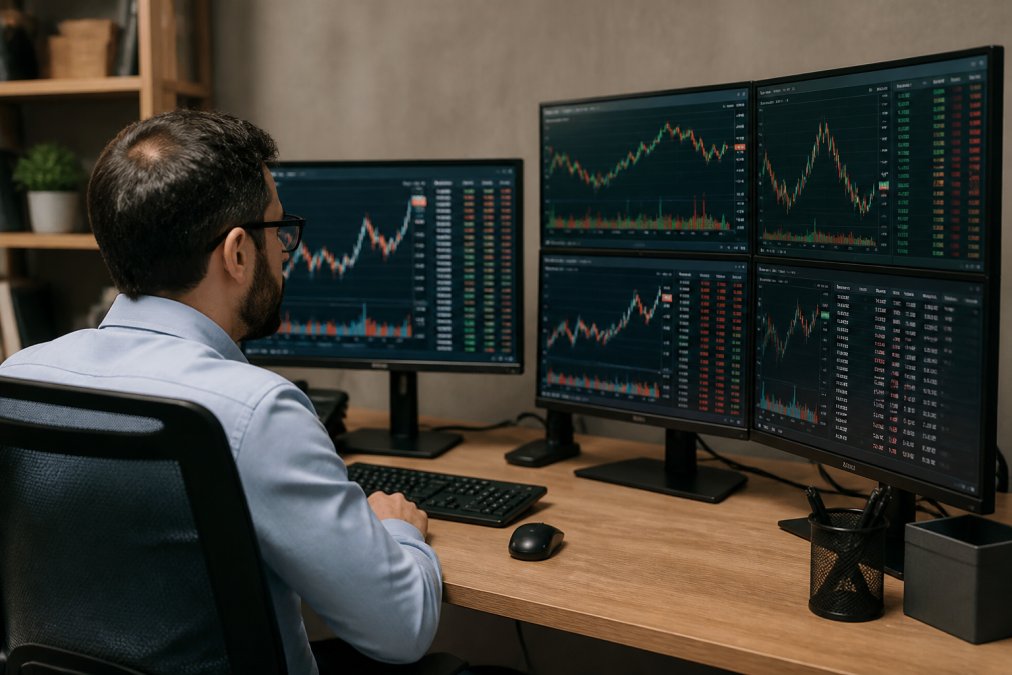
Real-time quotes with minimal delay (under 100 milliseconds) are essential. Level 2 data shows buy and sell orders at different price levels. Time and Sales data shows every individual trade execution.
Charles Schwab’s thinkorswim platform includes advanced charting with hundreds of technical indicators and drawing tools. TradeStation’s EasyLanguage lets traders code custom strategies and test them against historical data. NinjaTrader supports full algorithmic strategy development.
Order types determine your precision. Limit orders specify exact prices. Stop-loss orders automatically sell if price drops below a threshold. Trailing stops adjust automatically as price moves in your favor. Bracket orders combine entry, profit target, and stop-loss in a single order. Advanced platforms support all these; basic platforms may limit you to market and simple limit orders.
Execution speed matters during volatile markets. Interactive Brokers and NinjaTrader excel with sub-100ms execution. Robinhood and Webull are slower (typically 200-500ms) but fine for swing traders holding positions for hours or days.
Algorithmic Trading Platforms for Advanced Traders
API Access and Strategy Backtesting
Professional traders build custom trading bots using platform APIs. Interactive Brokers’ REST API lets developers submit orders, retrieve account data, and stream market quotes programmatically. The API supports Python, Java, C++, and other languages. Backtesting tools let you test strategies against historical data before deploying them live.
TradeStation’s EasyLanguage is a simplified programming language designed for trading strategies. You write rules in plain English-like syntax, and the platform handles order execution. Backtesting is built-in, running your strategy against 20+ years of historical data.
NinjaTrader’s C# API provides direct access to market data, order execution, and account management. Developers can build complex multi-leg strategies and implement machine learning models. The strategy analyzer shows profit/loss, win rate, and drawdown statistics from backtests.
Backtesting results are optimistic. Historical performance assumes you knew exactly when to enter and exit. Live trading involves slippage, commissions, and emotional decisions that backtest results don’t capture. Assume live performance will be 20-30% worse than backtests.
Tax Implications and Behavioral Trading Support
Understanding Tax Consequences of Active Trading
Short-term capital gains (positions held under one year) are taxed as ordinary income at your marginal tax rate, potentially 37% for high earners. Long-term capital gains are taxed at preferential rates (15% or 20%). The difference is substantial.
Day traders face additional complexity. Each round-trip trade generates a taxable event. A day trader executing 50 trades per week generates 2,600 taxable events per year. Tracking cost basis, holding periods, and wash sales becomes administratively burdensome. Many day traders hire accountants specializing in trader taxation, costing $2,000-$5,000 annually.
Wash sale rules prevent you from claiming losses if you repurchase the same security within 30 days. Fidelity and Schwab generate Form 8949 automatically. Interactive Brokers provides detailed tax lot tracking. However, active traders should consult a tax professional.
Psychological Tools and Trade Management
Emotions drive poor decisions. Overconfidence after winning trades leads to oversized positions. Fear after losses leads to panic selling. Revenge trading destroys accounts faster than any market crash.
Some platforms provide behavioral tools. Fidelity’s Active Trader Pro includes portfolio alerts and risk warnings. TradeStation’s charts show your entry and exit points overlaid on historical price data.
The most important behavioral tool is journaling. Successful traders maintain trade logs documenting the setup, entry reason, exit reason, and outcome. Paper trading lets you practice without emotional pressure. EZMT5’s automated systems reduce behavioral risk by removing human decision-making from trade execution.
Which Trading Program Is Right for You?
Day Traders and Active Investors
Day traders need speed and low fees. Pattern day trading rules require a $25,000 account minimum.
Interactive Brokers is the professional choice. The Trader Workstation delivers institutional-grade execution, advanced order types, and direct market access. Commissions are as little as $0.005 per share. Minimum account: $2,000.
TradeStation excels at fast execution for futures and options day traders. The platform provides advanced charting with pattern recognition and includes backtesting. Market data fees ($40/month) are waived if you trade actively. Minimum account: $5,000 for day trading.
ETRADE’s Power ETRADE platform combines commission-free stock trading with competitive options pricing ($0.50 per contract). Minimum account: $500 to open, $25,000 for day trading.
| Platform | Execution Speed | Commission | Best For | Account Minimum |
|---|---|---|---|---|
| Interactive Brokers | Sub-100ms | $0.005/share | Professional day traders | $2,000 |
| TradeStation | Sub-100ms | $0.39/micro | Futures day traders | $5,000 |
| E*TRADE | 150-200ms | $0 stocks | Options traders | $500 |
| Webull | 200-300ms | $0 stocks | Budget-conscious day traders | $0 |
Traders Building Automated Systems
EZMT5 is ideal for traders who want professional systems without building from scratch. The platform provides 11 fully optimized MT5 trading systems accessible immediately, with all future systems included. Two license keys per system let you deploy across multiple accounts or test different systems simultaneously. No contracts, cancel anytime.
Interactive Brokers suits developers building custom algorithms. The REST API supports multiple programming languages, historical data is readily available, and execution is fast.
TradeStation appeals to traders using EasyLanguage. The strategy backtesting is comprehensive, and the learning curve is gentler than full programming.
NinjaTrader serves the futures automation community. C# API access, advanced charting, and market replay tools support serious strategy development.
Beginner Traders Starting Out
Beginners should prioritize education, low minimums, and paper trading.
Fidelity is the safest starting point. Zero minimum, commission-free trading on stocks and ETFs, and integrated educational resources. Active Trader Pro is available as you develop skills.
Robinhood appeals to mobile traders who want simplicity. Fractional shares let you start with $1.
Charles Schwab combines beginner-friendly design with institutional-quality research. Paper trading is free and comprehensive.
| Platform | Best For | Minimum | Paper Trading | Learning Curve |
|---|---|---|---|---|
| Fidelity | Beginners building long-term skills | $0 | Yes | Gentle |
| Robinhood | Mobile-first traders | $0 | No | Minimal |
| Charles Schwab | Serious beginners | $0 | Yes | Moderate |
| Webull | Tech-savvy beginners | $0 | Yes | Moderate |
The platform you choose at the beginning isn’t permanent. Most traders migrate 2-3 times as their skills develop and their needs change. Start with something simple, learn the fundamentals, then move to more advanced platforms as your strategies require them.
Choosing the right trading program determines whether you execute trades profitably or lose money to poor execution and hidden costs. The best trading programs balance speed, transparency, and the specific tools your strategy demands. For traders deploying automated systems, EZMT5 eliminates months of strategy development by providing 11 fully built and optimized MT5 trading systems with instant access, real-time trade opportunities, and the flexibility to deploy across multiple accounts with changeable license keys. Start trading like a pro immediately after download with EZMT5.
Frequently Asked Questions
What is the best trading program for beginners?
Beginners benefit most from platforms offering commission-free trading, intuitive interfaces, and strong educational resources. Fidelity and Charles Schwab combine simplicity with professional tools, paper trading for practice, and extensive tutorials. Start with platforms that don't require large account minimums and provide real-time quotes without additional fees. Focus on learning order types, limit orders, and stop-loss mechanics before moving to complex strategies.
What features should I look for in trading software comparison?
Evaluate commission structures, account minimums, execution speed, technical analysis tools, and mobile app quality. Check whether the platform offers real-time market data, customizable charts, and multiple order types. For active traders, verify backtesting capabilities and API access for automation. Confirm regulatory compliance through SEC or FINRA registration. Mobile functionality matters if you trade on the go. Customer support availability and educational resources separate platforms that support growth from those that don't.
Are automated trading systems reliable for real money?
Automated systems can be reliable when built on sound methodology and tested in live conditions, not just backtests. Backtesting results often don't match live performance due to slippage, market volatility, and changing conditions. The most reliable approach combines automation with active monitoring, especially during market stress. Start with small position sizes to validate system performance in real markets. Verify that systems include stop-loss orders and position sizing rules to limit risk. Many traders use automation for entry signals but maintain manual oversight of exits.
How do algorithmic trading platforms differ from regular trading software?
Algorithmic trading platforms provide API access, backtesting engines, and developer tools for building custom strategies. Regular trading software focuses on manual order placement and charting. Platforms like Interactive Brokers and NinjaTrader offer REST APIs and strategy development environments. They support automated execution, order flow analysis, and high-frequency operations. Algorithmic platforms typically require technical skill or coding knowledge. They're designed for traders who need to test strategies systematically and execute trades without manual intervention.
What tax implications should I consider with active trading?
Active trading generates short-term capital gains taxed as ordinary income, typically at higher rates than long-term holdings. Day traders may qualify for Trader Tax Status with the IRS, allowing deductions for trading expenses. Track every trade for accurate reporting to the IRS. Consider wash-sale rules, which disallow losses if you repurchase the same security within 30 days. Consult a tax professional familiar with trading to understand your specific situation. Some traders use tax-loss harvesting to offset gains. Keep detailed records of entry prices, exit prices, and dates for all positions.
This article was written using GrandRanker