
Table of Contents
- MT5 Trading Systems vs Manual Trading: What’s the Real Difference?
- Head-to-Head Comparison Table: MT5 Automated Systems vs Manual Trading
- MT5 Expert Advisors vs Manual Trading: Execution, Speed, and Scalability
- Manual Trading Psychology vs Automation: The Emotional Bias Problem
- How to Backtest MT5 Trading Strategies Before Going Live
- Risks of Automated Trading Systems You Need to Know
- Which MT5 Trading Approach Is Right for You?
- Conclusion
Last Updated: May 19, 2026
The debate over MT5 trading systems vs manual trading is one of the most consequential decisions a serious trader faces in 2026. At EZMT5, we work with traders at every level, and the question comes up constantly: should you hand over execution to an Expert Advisor, or keep your hands on the wheel? The answer isn’t as clean as most guides suggest. Below, we’ll walk through the real trade-offs, the technical realities of running automated systems on MetaTrader 5, and exactly how to decide which approach fits your situation.
Here’s what most comparisons get wrong: they treat this as a binary choice. It isn’t.
MT5 Trading Systems vs Manual Trading: What’s the Real Difference?
Automated trading on MetaTrader 5 is the practice of using pre-programmed algorithms, called Expert Advisors (EAs), written in MQL5 to execute trades automatically based on defined rules without human intervention during each trade. Manual trading, by contrast, is discretionary trading where a human analyzes market conditions in real time and places orders based on judgment, technical indicators, and fundamental analysis.
The distinction matters because it determines everything downstream: your time commitment, your exposure to emotional bias, your scalability, and your ability to survive market volatility.
What Is Automated Trading on MetaTrader 5?
MetaTrader 5 is a professional multi-asset trading platform that supports algorithmic trading through its native MQL5 programming language. Expert Advisors are the engine of this automation. Once coded and deployed, an EA monitors markets, generates signals based on pre-defined logic (trend-following, mean reversion, scalping, etc.), and executes orders with a latency measured in milliseconds.
The MT5 platform also includes a built-in Strategy Tester for backtesting, a market depth view, and native VPS hosting integration. These aren’t cosmetic features. They’re the infrastructure that separates serious algorithmic trading from wishful thinking.
Key components of an MT5 automated system:
- Expert Advisor (EA): the core trading robot written in MQL5
- Technical indicators: the signal inputs (moving averages, RSI, Bollinger Bands, etc.)
- Risk management parameters: lot sizing, drawdown limits, stop-loss rules
- VPS hosting: ensures the EA runs 24/7 without interruption
- Backtesting module: validates strategy logic against historical data
What Is Manual (Discretionary) Trading?
Manual trading is the original model. A trader watches charts, reads market news, applies fundamental analysis, and makes order execution decisions in real time. Discretionary trading relies heavily on human intuition and pattern recognition, which can be an edge in certain market conditions.
The honest limitation: manual decision-making doesn’t scale. A human can monitor one or two instruments effectively. An EA can scan dozens simultaneously, around the clock, without fatigue.
Head-to-Head Comparison Table: MT5 Automated Systems vs Manual Trading
| Factor | MT5 Automated Systems | Manual Trading |
|---|---|---|
| Execution Speed | Milliseconds (low latency) | Seconds (human reaction) |
| Emotional Bias | Eliminated | High risk |
| Market Coverage | 24/7, multiple instruments | Limited by human attention |
| Backtesting | Full historical testing | Not possible |
| Scalability | High (runs multiple EAs) | Low |
| Adaptability | Requires reprogramming | Immediate human adjustment |
| Slippage Control | Better with VPS proximity | Higher slippage risk |
| Setup Cost | Higher initial investment | Lower entry barrier |
| Maintenance | Ongoing monitoring required | Continuous attention required |
| Best For | Systematic, rule-based strategies | News-driven, high-intuition setups |
This table is the starting point. The nuances below are where the real decisions live.
MT5 Expert Advisors vs Manual Trading: Execution, Speed, and Scalability
The gap between automated and manual order execution is wider than most traders expect. A well-configured EA on MetaTrader 5 with VPS hosting can execute an order in under 100 milliseconds. A human, even a fast one, takes at least one to three seconds from decision to execution. In high-frequency trading environments and fast-moving Forex markets, that gap translates directly into slippage and missed entries.
Scalability is the other side of this. One trader can realistically manage two or three open positions manually with discipline. An automated system can run multiple EAs across different currency pairs, indices, and timeframes simultaneously, without degradation in performance.
Time Efficiency and 24/7 Market Coverage
Forex markets run 24 hours a day, five days a week. Asian, European, and US sessions overlap and diverge in ways that create opportunities at hours when most traders are asleep. Manual trading forces you to choose which sessions to cover. Automated systems don’t have that constraint.
According to MetaTrader 5 official documentation on VPS trading, the platform’s VPS integration is specifically designed to keep Expert Advisors running continuously, independent of the trader’s local machine or internet connection. This is not a convenience feature. For strategies that depend on capturing overnight moves or reacting to off-hours news events, continuous operation is a prerequisite.
Pros and Cons of MT5 Automated Trading Systems
Pros:
- Eliminates emotional bias from trade execution
- Executes orders at speeds no human can match
- Runs 24/7 across multiple instruments simultaneously
- Backtesting against historical data validates strategy logic before live capital is at risk
- Consistent application of risk management rules (drawdown limits, position sizing)
- Scalable: add more EAs without proportional increase in time commitment
Cons:
- Requires ongoing monitoring: markets change, and an EA optimized for one regime can fail in another
- Technical failures (connectivity issues, broker server problems) can cause missed trades or runaway positions
- Initial setup complexity: writing or sourcing a reliable EA takes significant effort or cost
- Over-optimization risk during backtesting ("curve fitting") can produce EAs that perform brilliantly on historical data and poorly on live markets
Never deploy an EA on a live account without forward testing it on a demo account for at least four to eight weeks. Backtesting alone is insufficient. Market microstructure in live conditions differs from historical data in ways that can expose hidden flaws in your strategy logic.
Pros and Cons of Manual Trading
Pros:
- Immediate adaptability to breaking news and unusual market conditions
- No technical infrastructure required to get started
- Fundamental analysis and qualitative judgment can be incorporated in real time
- Lower upfront cost and setup complexity
Cons:
- Emotional bias: fear, greed, and overconfidence consistently degrade manual decision-making
- Physical limits: fatigue, distraction, and time zones restrict market coverage
- Inconsistent execution: the same trader makes different decisions under pressure
- No systematic way to validate a strategy before risking capital
- Profitability depends heavily on trading psychology, which is genuinely difficult to master
Manual Trading Psychology vs Automation: The Emotional Bias Problem
The emotional bias problem in manual trading is not a character flaw. It is a structural feature of human cognition under uncertainty, and it shows up in MT5 account data in specific, measurable ways that most traders never examine.
How Emotional Bias Actually Manifests in MT5 Trade Histories
Before comparing automation to manual trading on psychological grounds, it is worth understanding what emotional bias looks like in practice, because most traders believe they are less affected than they actually are.
Open your MT5 account history and look for these three patterns:
1. Asymmetric hold times between winners and losers.
If your losing trades are held significantly longer on average than your winning trades, you are exhibiting textbook loss aversion. You are letting losers run because closing them makes the loss real, and cutting winners early because locking in a gain feels safer than risking a reversal. This single pattern destroys positive expectancy even in strategies with a sound signal logic.
2. Position size escalation after a losing streak.
Manual traders frequently increase lot sizes after a drawdown period in an attempt to recover losses faster. This is the opposite of sound risk management. An EA applies the same lot sizing formula on every trade, regardless of the account’s recent history.
3. Skipped signals during high-volatility sessions.
If you track your manual signals and compare them to actual entries, most discretionary traders will find they skip a disproportionate number of valid signals during news events or after a recent loss. The signal logic did not change. The trader’s confidence did.
These are not abstract psychological concepts. They are patterns visible in your MT5 trade history report, which you can export under Account History > Save as Detailed Report.
Why Willpower Is the Wrong Solution
The standard advice for emotional bias is to "trade with discipline" or "follow your rules." This advice is structurally flawed because it treats discipline as a renewable resource. Research in cognitive psychology consistently shows that self-regulatory capacity depletes under sustained stress, a condition that active trading reliably produces.
The practical implication: a manual trader who performs well during calm morning sessions will make systematically worse decisions during the third hour of a volatile London-New York overlap, not because their strategy changed, but because their cognitive resources are depleted. This degradation is invisible to the trader in the moment.
Automated systems solve this structurally, not through improved willpower. An EA written in MQL5 executes the same exit logic at 9:00 AM on a quiet Tuesday and at 2:30 PM during a Federal Reserve announcement. The code does not experience decision fatigue.
The Specific MT5 Mechanisms That Remove Emotional Execution Risk
MetaTrader 5 provides several native tools that address emotional bias at the execution level, not just through full automation, but also for traders who want to reduce discretionary risk while remaining partially manual:
- Pending orders (Buy Stop, Sell Stop, Buy Limit, Sell Limit): Setting entry orders in advance removes the in-the-moment hesitation that causes manual traders to miss valid entries. The order fires at the pre-defined price whether or not the trader is watching.
- Hard stop-loss and take-profit at order placement: MT5 allows stop-loss and take-profit levels to be set at the moment of order entry. This removes the temptation to manually move stops during a trade. Many manual traders set stops but then widen them as price approaches, a behavior that is mechanically impossible if the stop is set at the broker level.
- EA partial automation: You do not have to choose between full automation and full discretion. An EA can be written to handle only exits and position sizing while leaving entries to manual judgment. This hybrid approach captures the emotional discipline benefits of automation on the highest-risk decision points (exits) while preserving human judgment on entries.
- MT5 alerts and push notifications: For traders who want to remain manual but reduce screen time, MT5’s alert system can notify you when price reaches a defined level, reducing the compulsive chart-watching behavior that amplifies emotional reactivity.
Discipline and Consistency: What Automation Actually Enforces
Trading discipline is what separates traders who survive long enough to develop an edge from those who blow up early. Automation enforces discipline structurally. But it is important to be precise about what it enforces and what it does not.
An EA enforces execution discipline: it applies the rules you coded, every time, without exception. It does not enforce strategy discipline: if the underlying rules are flawed, the EA executes flawed rules with perfect consistency. This is why the transition from manual to automated trading exposes a common and uncomfortable truth, a significant portion of many manual traders’ perceived edge is actually execution discipline (not revenge trading, not moving stops), not signal quality. When an EA removes the emotional friction from execution, mediocre signal logic becomes visible immediately in the equity curve.
The implication is actionable: before automating a strategy, run a manual trade journal for at least 30 trades and calculate your actual win rate, average risk-reward, and expectancy. If your manual results are already poor on a statistical basis, automation will not fix them. If your manual results are theoretically sound but inconsistently executed, automation is likely to improve them.
Emotional bias is not a problem you solve by trying harder. MT5 addresses it at multiple levels, from full EA automation to pending orders and hard stops, each of which removes a specific decision point from real-time human judgment. The right level of automation depends on where your execution breaks down, not on a binary choice between full manual and full automated trading.
How to Backtest MT5 Trading Strategies Before Going Live
Backtesting is the process of running a trading strategy against historical price data to evaluate how it would have performed. MetaTrader 5’s built-in Strategy Tester is one of the most capable backtesting environments available to retail traders, supporting multi-currency testing, real tick data, and optimization across parameter ranges.
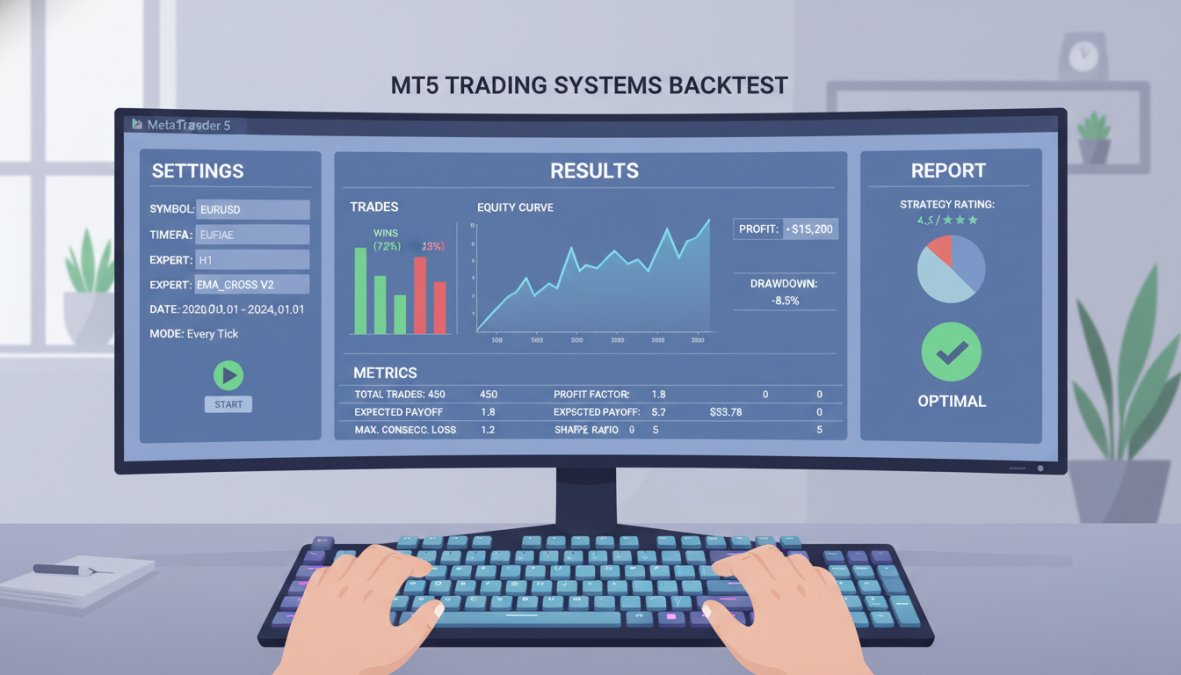
The process for backtesting an MT5 strategy:
- Open MetaEditor and load or write your EA in MQL5
- Open the Strategy Tester (Ctrl+R in MT5)
- Select the EA, instrument, and timeframe
- Choose "Every tick based on real ticks" for highest accuracy
- Set the date range (minimum three to five years of data recommended)
- Review key metrics: net profit, drawdown, Sharpe ratio, profit factor, and total trades
- Run optimization to identify parameter sensitivity
- Stress-test with slippage and spread settings that reflect live conditions
The output tells you whether the strategy has a positive expectancy over time. It does not guarantee future performance.
Backtesting vs. Forward Testing: Why Both Matter
Backtesting validates historical logic. Forward testing validates real-world behavior. These are not interchangeable.
Forward testing means running the EA on a demo account in live market conditions, with real-time price feeds and actual broker execution, for a defined period before committing live capital. A strategy that shows strong backtesting results but degrades significantly in forward testing has a problem: it was likely over-optimized to historical data.
The practical rule: if your forward test results deviate from backtesting results by more than 20-30%, treat the strategy as unproven and investigate the cause before going live. Common culprits include spread widening during news events, broker-specific execution differences, and data quality issues in the historical feed.
MT5 VPS Requirements for Running Expert Advisors 24/7
A VPS (Virtual Private Server) is a dedicated remote server that keeps your MT5 platform and Expert Advisors running continuously, independent of your local computer, internet connection, or power supply. For any automated strategy that needs to monitor markets outside your waking hours, a VPS is not optional.
Key VPS requirements for MT5 Expert Advisors:
- Operating System: Windows Server 2012 or later (MT5 is Windows-native)
- RAM: Minimum 512MB per MT5 instance; 1-2GB recommended for multiple EAs
- CPU: Single-core is sufficient for most EAs; high-frequency strategies need more
- Latency: Choose a VPS provider with servers geographically close to your broker’s execution server. Latency below 10ms is the target for time-sensitive strategies.
- Uptime guarantee: Look for 99.9% or higher
- Monthly cost: Typically around $30/month for a basic Forex VPS, as reflected in standard market pricing
Ask your broker whether they offer a free or subsidized VPS for active accounts. Many brokers provide this benefit, which eliminates the additional cost and guarantees server proximity to their own execution infrastructure.
Risks of Automated Trading Systems You Need to Know
Automated trading removes emotional risk. It introduces a different category of risk: technical and systemic.
The risks most traders underestimate when transitioning to automated systems:
- Over-optimization (curve fitting): An EA tuned too precisely to historical data performs poorly on new data. The more parameters you optimize, the higher this risk.
- Market regime changes: A trend-following EA built during a trending market will underperform in a ranging market. Automated systems don’t adapt to regime changes unless explicitly programmed to do so.
- Connectivity failures: If your VPS loses connection to the broker’s server, open positions can remain unmanaged. Always configure emergency stop-loss orders at the broker level.
- Broker dependency: Execution quality, spread conditions, and server stability vary by broker. An EA that performs well with one broker may not perform the same with another.
- Black swan events: Extreme market events (flash crashes, geopolitical shocks) can produce price action that falls completely outside the parameters an EA was designed to handle.
According to CFTC guidance on algorithmic trading risks, regulators have increasingly focused on the systemic risks posed by automated trading systems, particularly around position sizing controls and kill-switch mechanisms. Building hard drawdown limits into your EA is not just good practice; in regulated environments, it may be a compliance requirement.
Cost of Maintenance and Regulatory Compliance Risks
The real cost of running an automated trading system extends well beyond the initial setup. Ongoing maintenance is a genuine time and financial commitment that many traders overlook.
Maintenance costs to account for:
- VPS hosting: approximately $30/month for a basic setup
- EA licensing or subscription fees: varies significantly by provider
- Strategy review and recalibration: markets change, and EAs need periodic review to remain relevant
- Broker fees: spreads, commissions, and swap rates affect live performance differently than backtesting assumes
On the regulatory side, traders in jurisdictions with active financial regulation should verify that their automated strategies comply with local rules. Some regulators require disclosure of algorithmic strategies. Others place restrictions on high-frequency trading activity for retail participants. As noted by FCA regulatory framework for algorithmic trading, the compliance landscape for automated retail trading continues to evolve, and ignorance of applicable rules is not a defense.
The practical implication: factor maintenance costs and compliance review into your total cost of operation before comparing the profitability of automated versus manual approaches.
Which MT5 Trading Approach Is Right for You?
Most guides answer this question with a simple checklist. That is not enough. The right approach depends on four variables, your strategy type, your available time, your total cost of operation, and your regulatory environment, and the interaction between them is what most traders fail to think through before committing to one path.
Step 1: Diagnose Your Strategy Type First
The single most important variable is whether your edge is rule-based or judgment-based. This is not a preference question. It is a structural question about how your strategy actually generates returns.
Rule-based strategies have explicit, testable entry and exit conditions that do not require real-time interpretation. Examples: a moving average crossover with defined lot sizing and a fixed stop-loss; a mean-reversion strategy triggered by RSI crossing a threshold. These strategies can be fully expressed in MQL5 and backtested. They are candidates for automation.
Judgment-based strategies depend on qualitative interpretation that changes with context. Examples: trading central bank press conferences based on tone and language; reading order flow from Level 2 data during market open. These strategies resist automation because the decision logic cannot be fully codified. Forcing them into an EA strips out the judgment that generates the edge.
If you are unsure which category your strategy falls into, apply this test: write down your entry and exit rules in plain language with no ambiguous terms (no "when the market looks strong" or "if momentum is building"). If you cannot do this without using qualitative language, your strategy is judgment-based.
Step 2: Calculate Your Real Cost of Operation
This is the step most comparisons skip entirely, and it is the one that most directly affects whether automation is actually profitable for your situation.
Automated trading, ongoing costs to model:
| Cost Item | Typical Range | Notes |
|---|---|---|
| VPS hosting | ~$20-$50/month | Basic Forex VPS; higher for low-latency proximity hosting |
| EA licensing or subscription | Varies widely | Free (self-built) to several hundred dollars/month for commercial EAs |
| Broker spreads and commissions | Strategy-dependent | Scalping EAs are highly sensitive to spread; position trading EAs less so |
| Swap/rollover fees | Varies by instrument | EAs holding positions overnight accumulate swap costs that backtesting may underestimate |
| Periodic strategy recalibration | Time cost | Markets change; an EA that is not reviewed quarterly can silently degrade |
The practical implication: a commercial EA subscription at $100/month plus a $30/month VPS means your automated system needs to generate at least $130/month in net profit before it outperforms doing nothing. Factor this into your expectancy calculations before going live.
Manual trading, costs that are less visible but equally real:
- Opportunity cost of time: Active manual trading requires sustained attention. If your time has economic value elsewhere, that cost is real even if it does not appear on a brokerage statement.
- Slippage on manual entries: Manual execution during fast markets consistently produces worse fill prices than pre-set pending orders or EA execution. This cost is real but rarely tracked.
- Psychological cost: The cognitive load of active manual trading is not neutral. Many traders underestimate how much mental energy discretionary trading consumes, and how that affects decision quality over time.
Step 3: Assess Your Regulatory Environment
This is the factor that almost no retail trading guide addresses, and it is increasingly relevant as algorithmic trading regulation expands globally.
The regulatory landscape for automated retail trading varies significantly by jurisdiction:
- European Union (ESMA framework): Retail traders using automated systems are generally not subject to the same algorithmic trading registration requirements as institutional participants under MiFID II, but brokers operating in the EU are required to have controls around automated order flow. Traders should verify that their broker’s terms of service explicitly permit EA trading, some brokers restrict or prohibit specific EA behaviors (high-frequency scalping, latency arbitrage) in their client agreements.
- United Kingdom (FCA): The FCA’s framework for algorithmic trading focuses primarily on firms rather than retail clients, but retail traders using EAs through UK-regulated brokers should review their broker’s acceptable use policy. As noted by FCA regulatory framework for algorithmic trading, the compliance landscape continues to evolve.
- United States (CFTC/NFA): Retail Forex trading in the US is heavily regulated. Automated trading is permitted for retail clients, but the brokers available to US residents are limited to NFA-registered FCMs. Some EA strategies, particularly those involving hedging (holding simultaneous long and short positions on the same instrument), are prohibited under FIFO and no-hedging rules that apply to US retail Forex accounts. MT5 EAs that use hedging logic will not function as intended on US-compliant accounts.
- Other jurisdictions: Traders in regions with less developed regulatory frameworks should verify whether their broker is regulated at all before deploying automated capital. An unregulated broker combined with an automated system creates compounded risk: the EA may execute correctly while the broker fails to honor withdrawals.
Before deploying any EA on a live account, read your broker’s terms of service specifically for language around automated trading, scalping, and latency arbitrage. Brokers have the contractual right to void trades or close accounts that violate these terms, and EA traders are more visible to broker risk desks than manual traders because their order patterns are systematic and detectable.
Step 4: Match Your Profile to the Right Approach
Choose MT5 automated trading if:
- Your strategy is fully rule-based and passes the plain-language codification test above
- You cannot monitor markets during key sessions relevant to your strategy
- You want to trade multiple instruments simultaneously without proportional time increase
- You have verified that your broker permits EA trading and that your strategy type is allowed under applicable regulations
- You have budgeted for VPS, EA costs, and periodic maintenance as part of your total cost model
Choose manual trading if:
- Your edge is genuinely judgment-based and resists codification
- You are still in the strategy development phase and need the feedback loop of active decision-making to refine your approach
- Your strategy trades infrequently enough (a few times per week) that 24/7 automation provides no meaningful coverage advantage
- The total cost of automation (VPS, EA, maintenance time) would consume a disproportionate share of your expected returns given your account size
The hybrid approach, the most practical answer for most experienced traders:
MetaTrader 5 is explicitly designed to support hybrid operation. You can run EAs for systematic components (exits, position sizing, trailing stops) while retaining manual control over entries. You can use pending orders to remove emotional hesitation from entries while remaining fully manual on strategy selection. You can run an EA on one instrument while manually trading another in the same MT5 instance.
The hybrid approach is not a compromise. For traders whose edge combines systematic risk management with discretionary market reading, it is the structurally correct answer, and it is one that pure automation or pure manual trading cannot replicate.
EZMT5 is built specifically for traders who want to move into automated trading without spending months building and testing EAs from scratch. The platform provides instant access to 11 fully built and optimized MT5 trading systems and TradingView indicators, with two license keys per system that can be changed at any time, all under a no-contract monthly subscription. For traders who know they want automation but do not want to start from zero, that is a meaningful shortcut, and it eliminates the EA development cost line from the cost-of-operation model above.
Traders who have diagnosed their strategy as rule-based, calculated their total cost of operation, verified their broker and regulatory environment, and want to eliminate emotional execution risk without building an EA from scratch.
Conclusion
The MT5 trading systems vs manual trading decision ultimately comes down to what you’re trying to solve. If emotional bias and time constraints are limiting your results, automation addresses both directly. If your edge is fundamentally discretionary, forcing it into an EA will strip out the judgment that makes it work.
Frequently Asked Questions
Is automated trading on MT5 better than manual trading?
Neither approach is universally better, it depends on your goals, experience, and available time. MT5 trading systems using Expert Advisors excel at removing emotional bias, executing trades at high speed, and monitoring markets 24/7. Manual trading offers greater adaptability to sudden market news and fundamental analysis. Many serious traders use a hybrid trading approach, automating routine entries and exits while applying discretionary judgment for high-impact events.
What are the main risks of using MT5 automated trading systems?
The main risks of automated trading systems include over-optimization during backtesting (curve-fitting), technical failures such as connectivity loss or broker-side latency, and the inability to adapt to unexpected market volatility. There are also ongoing costs, including VPS hosting at roughly $30 per month, plus potential regulatory and compliance risks depending on your broker and jurisdiction. Regular real-time monitoring is essential even when running fully automated Expert Advisors.
Can beginners use MT5 automated trading systems effectively?
Yes, beginners can use MT5 trading systems, especially fully built and optimized solutions that require no coding knowledge. Platforms like EZMT5 offer pre-built Expert Advisors that are ready to deploy immediately after download. However, beginners should still understand basic risk management concepts, such as drawdown limits and lot sizing, and should always backtest any strategy using the MT5 Strategy Tester before committing real capital.
How do I switch from manual trading to automated trading on MT5?
Start by identifying a trading strategy you already use manually and document its rules clearly. Next, either code it in MQL5, use the MQL5 Wizard for a no-code approach, or subscribe to a pre-built Expert Advisor service. Run a thorough backtest in the MT5 Strategy Tester, then forward-test on a demo account. Once results are consistent, deploy on a live account using a VPS to ensure 24/7 uptime and minimal slippage.
Does manual trading offer better control than MT5 Expert Advisors?
Manual trading gives you real-time flexibility to react to breaking market news, geopolitical events, and shifting market conditions that pre-programmed algorithms may not account for. However, this perceived control often comes at the cost of trading discipline, emotional bias frequently leads to impulsive decisions. MT5 Expert Advisors enforce consistent rule-based execution, which many traders find produces more reliable profitability over time compared to purely discretionary trading.
What is the difference between backtesting and forward testing an MT5 strategy?
Backtesting uses historical price data inside the MT5 Strategy Tester to evaluate how a trading strategy would have performed in the past. Forward testing, also called paper trading or demo trading, runs the strategy in real-time market conditions without real capital at risk. Both are essential: backtesting reveals historical profitability and drawdown, while forward testing confirms whether the strategy holds up under live market conditions, including real spread, latency, and slippage.
Choosing between automated and manual trading shouldn’t mean starting from scratch on the technical side. EZMT5 gives serious traders immediate access to 11 professional, fully optimized MT5 trading systems and TradingView indicators, including all future systems, with the flexibility of two license keys per system and no long-term contracts. Signup Now and start trading with professional-grade tools from day one.
This article was written using GrandRanker